Classification
Learn about the branch of biology that classifies organisms into taxa, including the seven taxa system and the naming of organisms using binomial nomenclature. Discover the six kingdoms of life and classification based on evolutionary relationships.


Classification
E N D
Presentation Transcript
Taxonomy • The branch of biology that classifies organisms into taxa (taxon is singular)
The Seven Taxa • Kingdom (most diverse) • Phylum • Class • Order • Family • Genus • Species (least diverse)
If an organism is in the same family, then they are also in the same order, class, phylum, and kingdom. • For example, a bobcat, a house cat, and a lion are all in the same family (Felidae)
Comparing Dogs and Gorillas • Dog Gorilla • Kingdom Animalia Animalia • Phylum Chordata Chordata • Class Mammalia Mammalia • Order Carnivora Primates • Family Canidae Hominidae • Genus Canis Gorilla • Species familiaris gorilla
Red Panda Kingdom: Animalia Phylum: Chordata Class: Mammalia Order: Carnivora Family: Ailuridae Genus: Ailurus Species: A. fulgens
Naming Organisms • Organisms are named by their genus name followed by the species • Genus is ALWAYS capitalized and the species is ALWAYS lowercase. • Both names are italicized (or underlined if handwritten) • This system is called binomial nomenclature
When three scientific names are used to specify a subspecies, the system is called trinomial nomenclature • What is the scientific name for the red panda?
Who is more closely related? • The scientific name for a red maple tree is Acer rubrum • Quercus rubrum or Acer saccharum • Acer is the genus for maple trees • Quercus is the genus for oak trees
Who is the red panda closer related to? • Giant Panda or • Raccoon
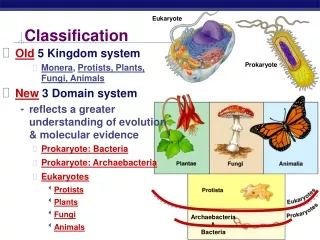
6 Kingdoms • Aristotle first classified organisms into 2 kingdoms: Plants and Animals • Microscopes changed the way we classify organisms and eventually they decided to go to a five kingdom system
Recent technology has shown that some bacteria have different gene sequences than any other organism on earth. • This led to the formation of a new kingdom: Archaebacteria • Most scientists use the 6 kingdom system
The Six Kingdoms • Archaebacteria- bacteria that live in extreme conditions • Eubacteria- (aka Monera) typical bacteria • Protista- algae, protozoa, slime molds • Fungi- molds, mushrooms, yeasts • Plantae- mosses, ferns, grasses, vegetable plants, trees • Animalia- sponges, jellyfish, worms, insects, fish, frogs, lizards, birds, kangaroos
Classification based on Evolutionary Relationships • Scientists look at more than just physical traits: fossil record and molecular data • The evolutionary history of a group of species is called phylogeny • Phylogenies are like family trees • The most common way to make evolutionary trees is cladistics (classification based on common ancestry) • A cladogram is an evolutionary tree
Methods of Transportation wings Passengers enclosed motor wheels