Building Your Health Triangle: Decision-Making and Balance in Life
180 likes | 287 Views
Discover how to draw your own health triangle and assess your physical, mental, and social well-being. Reflect on your current state of balance and explore ways to maintain equilibrium across all three components. The journal provides essential decision-making skills that protect your rights and health, including methods like pros and cons lists, and consulting experts. Learn about proactive and reactive decision-making styles, resistance skills for saying no, and the importance of self-trust. Create a plan to achieve your goals and cope with life's stressors.


Building Your Health Triangle: Decision-Making and Balance in Life
E N D
Presentation Transcript
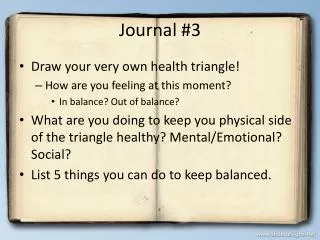
Journal #3 • Draw your very own health triangle! • How are you feeling at this moment? • In balance? Out of balance? • What are you doing to keep you physical side of the triangle healthy? Mental/Emotional? Social? • List 5 things you can do to keep balanced.
Decision Making Skills • Steps that enable you to make a healthful decision • These steps are designed to help you make decisions that protect your rights and health • It is important to seek advice from those with more experience then yourself
Many Ways to Make a Decision • Flipping a coin • Using tarot cards or astrology • Accepting the first option • Listing advantages and disadvantages • Asking an “expert” • Calculating each value • Using Decision Making Model
Protective Factors • being reared in a loving, functional family • being involved in school activities • having positive self-esteem • having clearly defined goals and plans to reach them • having close friends- regularly practicing one's faith • feeling a sense of accomplishment at school • having a role model • having a healthful attitude about competition and athletics • being committed to following community rules • having a plan to cope with life's stressors
Risk Factors - dysfunctional family- low self-esteem- being unable to resist peer pressure or influence- lacking faith experiences- genetically predisposed to chemical dependency- experiencing family disruptions- experiencing depression- experiencing academic and/or athletic pressure
Decision Making Styles • Inactive-Fail to make choices, and this failure determines what will happen. • Reactive-Allow others to make your decisions, influenced by what others think, wanting to be liked by others. • Proactive-Examine the decision to be made, identify and evaluate actions, select actions, and take responsibility (uses the decision making model).
Decision Making Tips • Do not make decisions that are not yours to make. • Avoid snap decisions. • Consider those affected by your decision. • Do your decision making on paper. • Trust yourself to make a decision and then to be able to field the consequences appropriately.
Resistance Skills • Skills that are used when you want to say no to an action or to leave a situation • Say no in an assertive way • Give reasons for saying no • Use nonverbal behavior to match verbal behavior • Avoid being in situations where there will be peer pressure • Resist pressure to engage in illegal behavior • Influence others to make responsible decisions
Decision Making Skills • These steps are designed to help you make decisions that protect your rights and health • It is important to seek advice from those with more experience then yourself
Many Ways to Make a Decision • Using tarot cards or astrology • Listing advantages and disadvantages • Calculating each value
We all have biases • Selective search for evidence • Repetition bias • Group think
Decision Making Styles • Inactive- • -Allow others to make your decisions, influenced by what others think, wanting to be liked by others. • -Examine the decision to be made, identify and evaluate actions, select actions, and take responsibility (uses the decision making model).
Decision Making Tips • Avoid snap decisions. • Do your decision making on paper.
Resistance Skills • Skills that are used when you want to say no to an action or to leave a situation