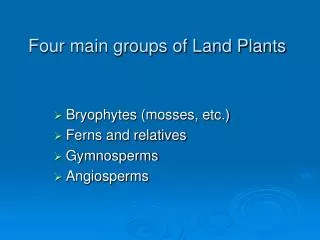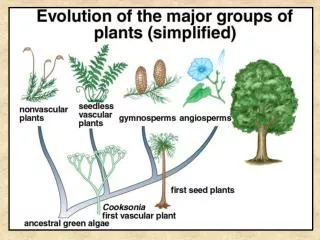
Land Plants fall into two major groups
600 likes | 1.19k Views
0. 0. Land Plants fall into two major groups. Non vascular Vascular. 0. Non-Vascular Plants. Lack vascular tissue Very small Known as the bryophytes. 0. The Bryophytes. Mosses. Liverworts. Hornworts. 0. Mosses. True mosses Sphagnum (Peat) mosses Granite mosses. 0.


Land Plants fall into two major groups
E N D
Presentation Transcript
0 Land Plants fall into two major groups • Non vascular • Vascular
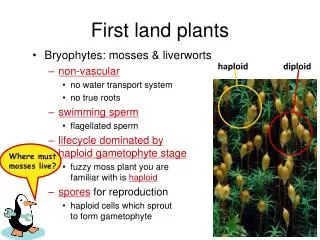
0 Non-Vascular Plants • Lack vascular tissue • Very small • Known as the bryophytes
0 The Bryophytes Mosses Liverworts Hornworts
0 Mosses • True mosses • Sphagnum (Peat) mosses • Granite mosses
0 True Mosses • Consists of structures resembling leaves stems and roots
0 True Mosses • “Leaves” have no veins • “Stems” have no vascular tissue
0 True Mosses • Reproduces by spores • Produced in a capsule
When operculum is shed peristome teeth are exposed Peristome regulates spore dispersal 0 True Mosses – The Sporophyte
0 Mosses • True mosses • Sphagnum (Peat) mosses • Granite mosses
Grow in Bogs Bogs may cover huge areas Moss absorbs water Water is acidified by the moss 0 Sphagnum (Peat) Mosses
Unique leaf structure allows leaves to absorb large quantities of water Moss absorbs water Water is acidified by the moss 0 Sphagnum (Peat) Mosses
Unique leaf structure allows leaves to absorb large quantities of water Moss absorbs water Water is acidified by the moss 0 Sphagnum (Peat) Mosses
Thick deposits of partially decomposed moss accumulates Deposits are known at Peat 0 Sphagnum (Peat) Mosses
0 Sphagnum and Peat are Harvested for Agriculture and Fuel
0 Acid pH and capacity for water retention make sphagnum a popular soil amendment
Peat has been harvest for centuries and burned for fuel 0 Sphagnum (Peat) Mosses
0 Bodies buried in Sphagnum Bogs are well preserved • Acid/anoxic environment retards bacterial growth Short video Mummies Frozen in Time
0 Land Plants fall into two major groups • Non vascular • Vascular
0 Vascular Plants • Vascular tissue • Some are seedless • Others produce seeds
0 Seedless Vascular Plants Whisk Ferns Club/Spike Mosses Horsetails Ferns
0 Whisk Ferns
0 Whisk Ferns • Dichotomous branching stems
0 Whisk Ferns • No roots – underground rhizome only
0 Whisk Ferns • No leaves- stem appendages are called enations
0 Whisk Ferns • Sporangia attached laterally on stem
0 Seedless Vascular Plants Whisk Ferns Club/Spike Mosses Horsetails Ferns
0 Plants with leaves have either microphylls or megaphylls • Microphylls have a single vascular strand • Megaphylls have a network of vascular strands
0 Club and Spike Mosses • Stems, roots and leaves • Leaves are microphylls
0 Club and Spike Mosses • Sporangia produced in axils of leaves
0 Club and Spike Mosses • Sporangia produced in axils of leaves
0 Seedless Vascular Plants Whisk Ferns Club/Spike Mosses Horsetails Ferns
0 Horsetails and Scouring Rushes
0 Horsetails and Scouring Rushes • Stems jointed • Branches whorled around stem
0 Horsetails and Scouring Rushes • Stems ribbed • Silica in cells of the epidermis
0 Horsetails and Scouring Rushes • Leaves small • Reduced megaphylls • Whorled at nodes • Underground rhizome with Roots
0 Horsetails and Scouring Rushes • Spores produced in terminal strobilous
0 Seedless Vascular Plants Whisk Ferns Club/Spike Mosses Horsetails Ferns
0 Ferns
0 Ferns show great diversity of form
0 Ferns have megaphylls
0 Young fern megaphylls are called fiddleheads
0 Fern stems grow vertically or horizontally
0 Spores are produced on underside of megaphylls
0 Spores are produced in clusters called Sori
0 Sori of many ferns are covered by an indusium