Limiting Reactants
This text explains the concept of limiting reactants in chemical reactions, illustrated through relatable analogies and examples. It details how to determine the limiting reactant based on available quantities, using the example of constructing houses with bricks and boards. By understanding that the limiting reactant determines the maximum amount of product that can be produced, the text guides readers through calculations involving chemical reactions. Specific examples include the production of iron(II) oxide from iron and oxygen and ammonia reacting with oxygen to form nitrogen monoxide.

Limiting Reactants
E N D
Presentation Transcript
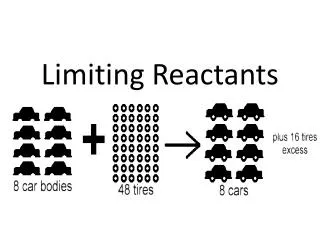
Limiting Reactant • If it takes 500 bricks and 1000 boards to make a house, how many houses can you make from 1600 bricks and 2000 boards? • 2 houses, there are enough bricks for 3.2 houses. but only boards for 2 with our plans (reaction). • In this analogy, the boards would be the limiting reactant. • We can’t make another house without the boards. • You may be able to make something else with the bricks, like a fire pit, but that would require a different set of plans (a different reaction).
Definition • Limiting reactant- the reactant that determines the amount of product that can be produced because of the amount of that reactant present. • Whichever reactant yields the LEAST amount of product is the limiting reactant.
Fe + O2 FeO 2 2 • If you have 87 g of Fe and 130 g of O2 how much iron (II) oxide can be produced? • Balance it first, then do the problem like before for both iron and oxygen. =110 g FeO =580 g FeO
Why the answer is 110 g FeO • We have enough oxygen to make 580 g FeO but enough iron to make 110 g, therefore we can only make 110 g. • The rest of the oxygen is excess (leftovers) • Iron is our limiting reactant • We can’t make more iron (II) oxide without more iron, regardless of how much oxygen we have.
Another Example 6 4 5 4 • NH3 + O2 NO + H2O • How much NO can be produced from 52 g of NH3 and 79 g of O2? =92 g NO =59 g NO