Download
1 / 14
140 likes | 265 Views
This article provides an in-depth exploration of crucial networking protocols and systems including TCP, UDP, ICMP, and RMON. It covers the functions of various layers in the ISO/OSI model, system identification through SNMP MIB-II, and the significance of IP address classes. Furthermore, it discusses key considerations for designing IT distribution rooms, such as equipment specifications, cooling requirements, and access control. This guide is essential for IT professionals and network engineers seeking to enhance their understanding of network architecture and management.

E N D
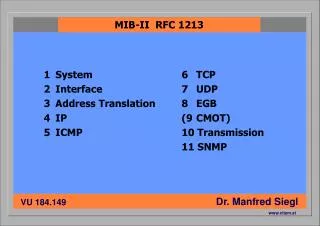
1 System 2 Interface 3 Address Translation 4 IP 5 ICMP 6 TCP 7 UDP 8 EGB (9 CMOT) 10 Transmission 11 SNMP MIB-II RFC 1213
Systems Group .1.3.6.1.2.1.1 1 sysDescr 2 sysObject ID 3 sysUpTime 4 sysContact 5 sysName 6 sysLocation 7 sysServices
ifNumber ifIndex ifDescr ifType ifMtu ifSpeed ifPhysAddress ifAdminStatus ifOperStatus ifLastChange IfInOctets ifInUcastPkts ifinNUcastPkts ifInDiscards ifInErrors ifInUnknownProtos Interface Group .1.3.6.1.2.1.2 • ifOutOctets • ifOutUcastPkts • ifOutNucastPkts • ifOutDiscards • ifOutErrors • ifOutQLen
RMON - Remote Monitoring Beobachtung der Ressourcen durch eine RMON-Probe an einer entfernten Stelle im Netz und Übermittlung der Ergebnisse über SNMP • Ethernet statistics • history control • ethernet history • alarm • host • hostTopN • matrix • filter • packet capture • event
RMON2 - Remote Monitoring 2 • protocol directory • protocol distribution • address mapping • network layer host • network layer matrix • application layer host • application layer matrix • user history • probe configuration
ISO/OSI Layer Model Anwendungsschicht 7 Gateway 7 Darstellungsschicht 6 6 Kom.steuerungsschicht 5 5 Transportschicht 4 4 Vermittlungsschicht 3 Router 3 Sicherungsschicht 2 Bridge/Switch 2 Bit-Übertragungsschicht 1 Repeater/Hub 1
Paketaufbau TCP / IP / Ethernet UDP/TCP Header Layer 3 Router Layer 2 Switch Bridge Layer 1 Repeater Hub Port IP Header Dest Src Eth Header CRC Dest Src Eth Präambel
MAC Adresse IP-Adresse Internet-Name 00 : 00 : 21 : 6B : 93 : AC 128 . 130 . 2 . 9 www . tuwien . ac . at Kennzeichnung eines Knotens
Class A Class B Class C 0_______.________.________.________ 11111111.00000000.00000000.00000000 255.0.0.0 10______.________.________.________ 11111111.11111111.00000000.00000000 255.255.0.0 11______.________.________.________ 11111111.11111111.11111111.00000000 255.255.255.0 IP ADDRESS CLASSES
Struktur gemäß EN50173 ASG: Anwenderspezifische Geräte SV: Standortverteiler GV: Gebäudeverteiler EV: Etagenverteiler KV: Kabelverteiler TA: Endknotenanschlüsse SV ASG GV GV ASG ASG EV ASG ASG ASG ASG KV KV TA TA TA TA
Kriterien für einen IT-Verteilerraum 19-Zoll Schränke (80x80x220cm³) vorne 1m20, hinten 80cm • Platzbedarf 1000 bis 1500 Watt Abwärme je 19-Zoll Schrank • Wärmeentwicklung Kühlventilatoren mit hoher Lärm-entwicklung - für Arbeitsplatz-räume nicht geeignet • Lärmentwicklung Unautorisierten Zugang verhindern • Zugänglichkeit separate FI/LS (2 je Schrank), USV, Überspannungsableiter • Stromversorgung Fernsignalisierung der Zustände, Wartungspersonal vor Ort • Management
Kriterien für die Kabelauswahl • Kabeldurchmesser (6mm bis 20mm) • minimale zulässiger Biegeradius (5cm bis 35cm) • maximale Zugkraft (150N bis 3000N) • maximale verlegbare Länge (90m bis 2km oder mehr) • Dimensionierung und Ausführung der Tragsysteme • Fehleranfälligkeit im Benutzerbetrieb • einsetzbare Technologien • Eigenschaften im Brandfall (Brennbarkeit, rauchhemmend, säurebildend)
Shielded Twisted Pair - STP 4 einzeln verdrillte Adernpaare, jedes Paar mit leitender Folie geschirmt, gemeinsam verseilt, im gemeinsamen Kabelmantel,optional mit gemeinsamen Geflechtschirm STP-C 2x 2STP-C
Unshielded Twisted Pair - UTP 4 einzeln verdrillte Adernpaare,gemeinsam verseilt, im gemeinsamen Kabelmantel,optional mit gemeinsamen Folienschirm UTP S-UTP