Download
1 / 23
230 likes | 350 Views
This educational packet delves into significant biological issues, including bioterrorism and the emergence of avian flu pandemics. It explores the implications of biochemical agents used for terrorist purposes, the role of embryonic stem cells in medical advances, and the effects of overpopulation and global warming on biodiversity. A key focus is on the scientific method, highlighting essential steps such as observation, hypothesis formation, and experimental design, enabling students to comprehend the systematic approach scientists take to investigate natural phenomena.

E N D
ISSUES IN BIOLOGY & THE SCIENTIFIC METHOD Packet #1 Chapter #1 AP Biology
BIOTERRORISM • Bioterrorism • The use of biochemical agents for terrorist purposes. • Biowarfare • Use of disease-producing microorganisms or biocides to cause death or injury to humans, animals and/or plants • Biochemical Agents • Pathogens • Anthrax • Bacillus anthracis • Smallpox • Variola major • Agriculture pesticides
AVIAN FLU PANDEMIC • Refers to influenza A viruses found chiefly in birds • Some infections, caused by the virus, can be carried over to the human population • Hong Kong 1997 • Virginia 2002 • New York 2003 • Vietnam 2005 • Iraq 2006 • http://www.cdc.gov/flu/avian/gen-info/avian-flu-humans.htm
EMBRYONIC STEM CELLS • Ability to develop in different cell types • Treat diseases, conditions and disabilities • http://stemcells.nih.gov/index.asp
OVER POPULATION • Condition of any organism’s numbers exceeding the carrying capacity of its ecological niche. • How does this relate to humans? • http://www.answers.com/over%20population
EMERGENT DISEASES • http://www.cdc.gov/ncidod/id_links.htm
GLOBAL WARMING • Increase in earth’s average temperature and the climatic impacts that it may have.
BIODIVERSITY • Biodiversity • The variability among living organisms on the earth, including the variability within and between species and within and between ecosystems. • A goal of scientists is to discover the effects of the previously mentioned not only on humans, but the estimated 7 – 20 million species on earth. • How do we do that?
SCIENTIFIC METHOD • Manner for investigating nature • Scientists attempt to construct an accurate, reliable, consistent and non-biased representation of the natural world • Few scientists adhere to the “strict procedures” • Creativity, individuality, distinct
SCIENTIFIC METHOD • Scientific Theories • 2 components • Describes the patterns seen in the natural world • Identifies a process or mechanism responsible for a pattern • Biology • A study of patterns of living things and their processes
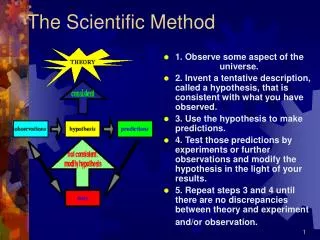
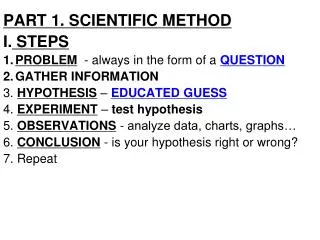
SCIENTIFIC METHODCOMMON STEPS • Observation • An observation is made regarding some event or characteristic of the world • A problem is developed • An open-ended question that cannot be answered by a yes or no answer
SCIENTIFIC METHODCOMMON STEPS • Forming a Hypothesis • Postulating a premise • An explanation of the phenomena observed • Predict the existence of other phenomena or predict quantitatively the results of new observations • States results that may be expected from observations and/or from experimental tests • Can be based on one’s experience creativity or a sense of what is practical • Involves critical thinking and critical analysis • Deductive reasoning • Reasoning from a general observation to a specific conclusion • Inductive reasoning • Reasoning from a specific case to the general • Hypothetico Reasoning • Hypothesis developed Prediction deduced Tested against empirically derived data
SCIENTIFIC METHODCOMMON STEPS • Experiment & Experimental Design • Unbiased • Disprove a hypothesis • Evaluate an alternate hypothesis • Null hypothesis • College/University • Testing the hypothesis • Determining whether prediction is correct
SCIENTIFIC METHODCOMMON STEPS • Experiment & Experimental Design • Methods and Procedures • Adaptable • Able to reexamine as new information is collected • Suppose to test a premise • Best when designed to “disprove” a hypothesis • Often said in science that theories can never be proved but only disproved • A hypothesis can never be proven but evidence, collected during experimentation, can be used to support
EXPERIMENT III • Experiment & Experimental Design • Variables must be defined • Dependent Variables • Measureable and observable things • Independent variable • Should be only one during an experiment • Can be manipulated and changed • Controlled variables • Kept constant and not allowed to change • *Control • All experiments should have one • Used as standard f comparison
SCIENTIFIC METHODCOMMON STEPS • Collection of Results & Interpretation of Data • Must use same criteria (technique) for collecting all data • Representation of Data • Tables • Graphs • Interpretation of Data/Statistical Analysis • T-test • Compares the means of two groups • ANOVA • Compares the means of three or more groups • Chi Square • Compares how closely the observed data is to the expected results • *Experimenters should also look at the variance
SCIENTIFIC METHODCOMMON STEPS • Conclusion • Does the experiment match your predictions? • Is your hypothesis supported • Does your results agree with other findings? • Replicate the experiment
Scientific Law • Hypothesis whose predictions have stood up to thorough and rigorous testing with experiments and observations.
LIMITATIONS OF THE SCIENTIFIC METHOD • Some hypotheses are not experimental • Intelligent beings in the universe • Global warming • *Theory of evolution