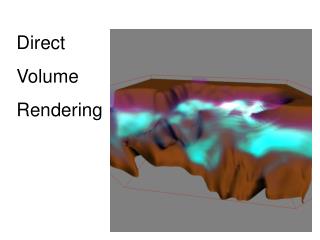
Efficient complementary viewpoint selection in volume rendering
This paper presents a novel approach for selecting optimal complementary viewports in volume rendering. It introduces scoring descriptors based on environment-dependent, object-dependent, and viewpoint-dependent criteria, including projected area and visibility of objects. The research emphasizes the significance of self-occlusions and luminance in effective rendering. Various simulations and live user evaluations validate the methodology's effectiveness. The results demonstrate improved viewpoint selections leading to enhanced visual representations, pushing forward techniques in dynamic time warping and shape similarity assessments.


Efficient complementary viewpoint selection in volume rendering
E N D
Presentation Transcript
Efficientcomplementaryviewpointselection in volumerendering S. Grau, A. Puig, S. Escalera, M. Salamó and O. Amorós
Scoring - Descriptors Environment-dependent Object-dependent Viewpoint-dependent
Scoring - Descriptors Projected area Number of visible objects Occlusion between objects Environment-dependent Object-dependent Viewpoint-dependent Object self-occlusions Luminance
Similarity Number of objects? Projectedarea per object? Projectedshape? VS
Similarity Number of objects? Projectedarea per object? Projectedshape? VS
Similarity Number of objects? Projectedarea per object? Projectedshape? VS
Similarity Number of objects? Projectedarea per object? Projectedshape? VS
ShapeSimilarity VS 2x
ShapeSimilarity Dynamic Time Warping
ShapeSimilarity Dynamic Time Warping
Simulations Live-UserEvaluation
Simulations Systemsetup Live-UserEvaluation
Efficientcomplementaryviewpointselection in volumerendering S. Grau, A. Puig, S. Escalera, M. Salamó and O. Amorós