Download
1 / 9
90 likes | 205 Views
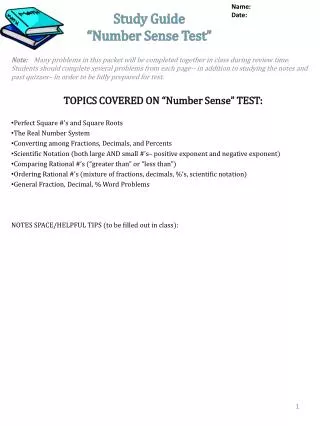
This study guide is designed to help students prepare for the Number Sense Test. It covers key topics including perfect squares, square roots, the real number system, and conversions among fractions, decimals, and percents. Students should actively participate in class review, completing exercises from the guide, and studying notes and past quizzes. Topics also include scientific notation, comparing and ordering rational numbers, and solving word problems. Use this guide to ensure comprehensive preparation for the upcoming test!

E N D
Name: Date: Study Guide “Number Sense Test” Note: Many problems in this packet will be completed together in class during review time. Students should complete several problems from each page-- in addition to studying the notes and past quizzes– in order to be fully prepared for test. TOPICS COVERED ON “Number Sense” TEST: Perfect Square #’s and Square Roots The Real Number System Converting among Fractions, Decimals, and Percents Scientific Notation (both large AND small #’s– positive exponent and negative exponent) Comparing Rational #’s (“greater than” or “less than”) Ordering Rational #’s (mixture of fractions, decimals, %’s, scientific notation) General Fraction, Decimal, % Word Problems NOTES SPACE/HELPFUL TIPS (to be filled out in class):
Square Roots Fill in the missing information in the below “perfect square” table: Find the square root of the following numbers: Between which two consecutive WHOLE numbers do the following #’s fall between?: 21 Nancy wants to plant a square garden. The area of the garden will be 86 sq. ft. About how long will each side be? __________ 22. What perfect square # does the square to the right represent? __________ What is its square root? __________
Real Number System Use the below word bank to correctly label the subsets of the Real Number System onto the below diagram: Use the above diagram to place the following numbers into the SMALLEST SUBSET (most specific) of the Real # System that each number is a member of:
Real Number System Multiple Choice: Which number is an integer, but not a whole number? A. 26 B. 17 C. 0 D. -5 Which number is irrational? A. √36 B. √15 C. √9 D. √4 Which subset of real numbers contains √12? A. Integers B. Rational #’s C. Irrational #’s D. Natural #’s Which number is rational? A. 925.96 B. √23 C. π D. -√37 Which number is a natural, whole, and integer number? A. 14 B. 0 C. -2 D. -13 Answer the following statements with “TRUE” or “FALSE.” 6. ____________________ All integers are also rational. ____________________ All natural numbers are also integers. ____________________ All integers are also natural. ____________________ All square roots are irrational. ____________________ Zero is a natural number.
Fraction, Decimal, Percent Fill in the below missing spaces by converting among fractions, decimals, and percents:
Scientific Notation Convert the following numbers into scientific notation. 4,500,000 0.000064 15,013,000 230,000,000,000 1,200 0.0000924 0.0043 Convert the following numbers into standard notation: 2.5 x 10³ 3.025 x 10⁻² 8.452 x 10⁷ 9.36 x 10⁻⁵ 4.23 x 10⁴ 2.8 x 100 7.4 x 10⁻⁶ Rewrite the following numbers in ascending order. 1.1x10⁻⁴ 9.1x10¹⁰ 6.41x101 7.234x10⁻⁸ 16. 9.231x100 1.34x10⁻⁵ 3.202x10⁻³ 6.2x10⁻²
Ordering Numbers Put the following in ascending order: ¾, 75.5%, .7, .07, 7.5 x 10³ 1/2, 51%, .05, 5.01 x 10⁻² 22%, 1/50, 2/5, 2.5 x 101 6.6 x 10⁻¹, 2/3, 0.06, .65% Put the following in descending order: .037, 37%, 3/8 , 0.3, 3.7 x 10⁻⁴ 9/10, 9%, 0.009, 9.15 x 10³ 7/4, 231%, 1.4, 2.5 x 10³ 7/8, 0.8%, 0.78, 7.5 x 10⁻²
Multiple Choice: 1. Which of the following is equivalent to 5/8 ? 2. Four students recorded their scores on a quiz in different ways. Which score is the highest? 3. Which of the following is equivalent to 0.85? 4. Which of the following is not equivalent to the other three ? 5. Which number has the greatest value? 6. Which number has the least value?
Thinking Questions Draw a picture of a perfect square. How do you know that it is a perfect square? What is the difference between a perfect square and a non perfect square? Why does every square root have a positive answer and a negative answer? Why can there never be a negative sign on the inside of a radical symbol? Can a fraction be an integer? Are all square roots irrational numbers? How do you classify non-ending decimals? Why is it useful to write numbers in scientific notation? What is the difference between a negative power and a positive power? Place the following numbers in order on the below number line: 1