Data-Validated Simulation of Calorimeter Sub-Detectors: Innovations and Future Directions
This document explores comprehensive data-validated simulations aimed at enhancing the performance of calorimeter sub-detectors, particularly focusing on Particle Flow Algorithms (PFA) and their significant influence on calorimeter design. It discusses various aspects, including algorithm development (PandoraPFA, gNIKI, MAGIC), global detector optimization, and addressing mechanical imperfections. The study emphasizes the relevance of existing detector concepts and potential improvements, including material descriptions and advanced tracking methods. Future research directions will also be suggested to align with UK hardware interests.

Data-Validated Simulation of Calorimeter Sub-Detectors: Innovations and Future Directions
E N D
Presentation Transcript
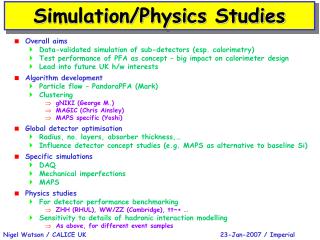
Simulation/Physics Studies • Overall aims • Data-validated simulation of sub-detectors (esp. calorimetry) • Test performance of PFA as concept – big impact on calorimeter design • Lead into future UK h/w interests • Algorithm development • Particle flow – PandoraPFA (Mark) • Clustering • gNIKI (George M.) • MAGIC (Chris Ainsley) • MAPS specific (Yoshi) • Global detector optimisation • Radius, no. layers, absorber thickness,… • Influence detector concept studies (e.g. MAPS as alternative to baseline Si) • Specific simulations • DAQ • Mechanical imperfections • MAPS • Physics studies • For detector performance benchmarking • ZHH (RHUL), WW/ZZ (Cambridge), tt~+ … • Sensitivity to details of hadronic interaction modelling • As above, for different event samples Nigel Watson / CALICE UK
What next? • Missing tools for physics studies? • Beam-related background • Overlaying of lcio files (background/signal) – NKW-> Norman Graf • Generator level cuts to improve statistics of selected background samples for channels with very low signal/background, e.g. ZHH • RHUL – talk to Marcel S., on filtering .stdhep files • Vertexting – c/o LCFI – package to be released soon (~mid-Feb?) • Tracking – complicated task - Alexei R. et al • Lepton id • m-id – not much in near future • Electron-id (relates to test beam data analysis). No technical show stoppers. • Improved description of detector in forward regions (MDI, …)? • Material description itself exists, ~adequate • Improve impact of existing work • Other detector concepts – problems e.g. with track reco in Marlin framework of SiD • Concentrate on LDC for immediate future (reconsider in ~0.5 year) • Be prepared to present work in progress at meetings, write up as LC-Notes • Is SiW too expensive, can adequate performance be obtained with small scintillator tiles? Ideally, make “like-with-like” comparison using LDC, compare SiW with scintillator. Perhaps interest from new Japanese Calice collaborators? Discuss at DESY meeting. • Better co-working with more people now involved? • Avoid (too much) duplication / “re-inventing of wheel” • Much interest in tt~ - better to concentrate on different aspects of this process, or alternative channels • Sharing code where appropriate (likely to be more ad hoc than Calice reco code) • Private web pages, sourceforge, institute/collaboration wikis, etc. • … Nigel Watson / CALICE UK