UDP-Based Delivery: Enhancing Flow Control and Congestion Response with HPF Architecture
270 likes | 376 Views
Explore how UDP-based applications can effectively manage end-to-end congestion control and flow control using the HPF architecture, ensuring timely delivery, packet prioritization, and scalability against competing TCP flows. Learn about HPF layers, congestion control, and its benefits over traditional TCP modifications.


UDP-Based Delivery: Enhancing Flow Control and Congestion Response with HPF Architecture
E N D
Presentation Transcript
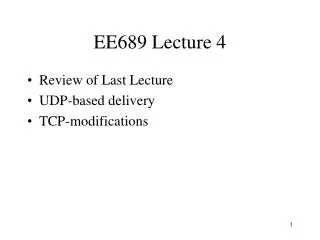
EE689 Lecture 4 • Review of Last Lecture • UDP-based delivery • TCP-modifications
End-to-End Congestion • UDP-based applications should do end-to-end congestion control • Otherwise -- BW divided unfairly • -- Loss of Goodput • TCP-friendly -- enforce TCP-like control • Hard to enforce TCP-friendly mechanism • Multiple connections/IP-spoofing get around those mechanisms.
UDP-based delivery • “Nice” Applications will follow end-to-end congestion • All of the flow control/congestion control reliability to be built into application. • ALF - Application Level Framing - design principle - advocates application level of transport mechanisms.
UDP-based delivery • Packet-pair: One mechanism for BW estimation • Send two packets back-to-back, measure the delay between acks • ACK Compression - Receiving timestamps • Round robin scheduling /FIFO • Minimum ack spacing indicates link BW
Cyclic UDP • Developed at UC Berkeley • Notion of rounds -- data sent in a fixed size time units • Retransmit data within the round • Move on to next round if data not received within round • Apply flow control within the round.
Cyclic UDP • Prioritize packets within round • Order higher priority packets in front • CUDP improves chances of delivery of higher priority packets -- retransmissions have higher priority • NACK - indicate not received packets so far on each packet reception
Cyclic UDP • Rounds allow timely delivery • Rounds allow prioritization of current packets • Application prioritizes within the round • Uses delay and packet losses for determining available BW
Estimating BW • Loss rate = 1 - bytes recvd/ bytes sent • Expected loss rate = X • Expected delay = D1 • If (L > X) EstBW = (1-L)*LtBW/(1+X) else if (meanDelay > D1) EstBW = (1+X)*LtBW*D1/meanDelay else EstBW = (1+X)*LtBW
Cyclic UDP • Adapts to Congestion • Assumes all available BW can be used • Not clear what happens to competing TCP applications • Results indicate multiple CUDP flows share available BW • Loss rate -- scalability ??
Stored Media/Live Media • Stored Media allows buffering of data, can tolerate startup delays • More buffering -- more chances of overcoming congestion/smoother playout • Buffering => Longer latencies, not acceptable for interactive applications • Vxtreme etc. exploit buffering
CUDP Summary • Possible to design adaptive flow control into UDP application • Allows Timely Delivery and discard of expired packets, prioritization • Shown to scale against CUDP apps. • Not clear if more aggressive than TCP • Not a multiplicative decrease response
TCP Modifications • If TCP congestion/flow control is so good, why not retain it? • Easy to show that “TCP-friendly” • Get rid of reliable/in-order delivery mechanisms that get in the way. • HPF = Heterogeneous Packet Flows
HPF • Allows marking packets high/low priority • Provides In-order reliable delivery of high priority packets • Allows low priority packets to be delivered when enough BW available • If routers support priority, can drop low priority packets ahead of high priority packets
HPF Layers • Application Framing (AF) -- convert frames into packets, packets into frames • Windowing, Reliability, Timing and Flow-control (WRTF) -- window management, flow control, reliability, deadlines • Congestion Control (CC) -- congestion response, estimation of RTTs
HPF • Separate the reliable delivery from windowing mechanisms. • Advance rcv_next pointer based on Reliable packets • Compute fraction of packets lost as opposed to based on sequence numbers -- a burst of losses doesn’t lead to cwnd being set to 1. • Multiplicative Decrease/Additive Increase
HPF Congestion Control • If ack_fraction > , cwnd = fi(cwnd), fi = TCP slow start • If ack_fraction < , cwnd = fd(cwnd), fd = 1/(1/cwnd + 1 - ack_fraction) • = 1 - random loss probability
Summary • UDP-based delivery puts application in charge to do flow control, congestion response etc. -- ALF plus more • Tedious for every application to implement all the basic mechanisms • Separate ALF policies and implementation -HPF does this and follows TCP based congestion response