The Eternal Beauty: A Literary Analysis of Sonnet 18
In this analysis of Sonnet 18, we explore the poem's themes of beauty and immortality through nature comparisons. The speaker likens their beloved to a summer's day, noting its imperfections and fleeting nature. The poem employs the ABAB CDCD EFEF GG rhyme scheme, emphasizing how love and poetry can preserve beauty beyond the ravages of time. Each quatrain builds on the notion that while summer fades, the beauty of the beloved will remain eternal in verse, ensuring their legacy lives on for generations.

The Eternal Beauty: A Literary Analysis of Sonnet 18
E N D
Presentation Transcript
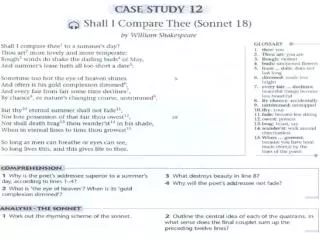
Comprehension • She is more beautiful and more temperate and does not fade away like a summer’s day. • The eye of heaven is the sun. It is dimmed by clouds and bad weather. • Time destroys beauty. • Because she will be immortalized in poetry.
Analysis • ABAB CDCD EFEF GG • First quatrain: The poet’s addressee is lovelier than a summer’s day. A summer’s day is imperfect because strong winds may destroy it and summer itself only lasts a short time. • Second quatrain: Comparing his addressee to the sun the poet says that is often too hot or covered by clouds. Chance and change work on the things of the world and detract from their beauty. • Third quatrain: The beauty of poet’s addressee will not fade or die because the poet has immortalized it in these lines. • The couplet: The poem sums up what he has already said by point out that as long as men live and can read, the addressee’s beauty will continue to live on, unchanged, in these lines.