Understanding Improper Integrals: Limits and Convergence
This section explores improper integrals, focusing on those with infinite limits and integrands. We establish that if the limit is finite, the integral converges to that value. Conversely, if the limit is infinite, the integral diverges. Additionally, when both limits are finite, the integral converges to the defined value. The implications of infinite limits and integrands are crucial for determining the behavior of integrals in mathematical analysis. This guide brings clarity to the concept of convergence in improper integrals.

Understanding Improper Integrals: Limits and Convergence
E N D
Presentation Transcript
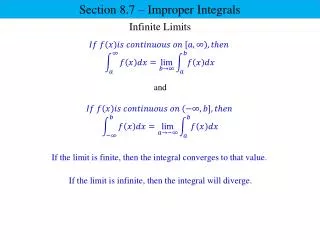
Section 8.7 – Improper Integrals Infinite Limits and If the limit is finite, then the integral converges to that value. If the limit is infinite, then the integral will diverge.
Section 8.7 – Improper Integrals Infinite Limits If the both limits are finite, then the integral converges to that value. If the one of the limits is infinite, then the integral will diverge.
Section 8.7 – Improper Integrals Infinite Integrands If the limit is finite, then the integral converges to that value. If the limit is infinite, then the integral will diverge. If the limit is finite, then the integral converges to that value. If the limit is infinite, then the integral will diverge.
Section 8.7 – Improper Integrals Infinite Integrands c is in the interval, and , then If the both limits are finite, then the integral converges to that value. If the one of the limits is infinite, then the integral will diverge.