Download
1 / 18
190 likes | 392 Views
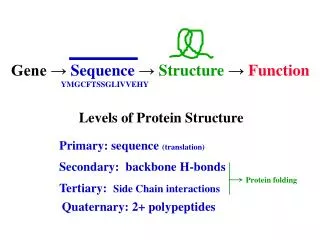
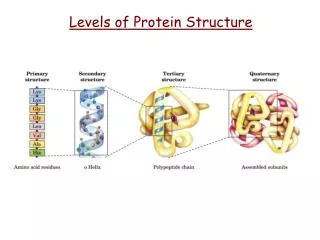
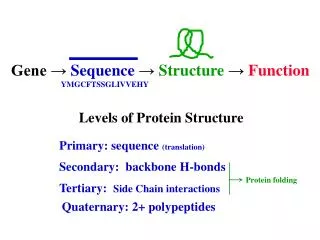
This text discusses various levels of protein structure, emphasizing secondary structures like pleated sheets and the impact of covalent disulfide bonds formed between cysteine units. It highlights how these structural features can affect the properties of proteins, such as hair texture influenced by disulfide bonds. Additionally, it covers the quaternary structure of proteins like hemoglobin and insulin, which consist of multiple chains and play key biological roles. Understanding these structures helps elucidate protein functionality in living organisms.

E N D
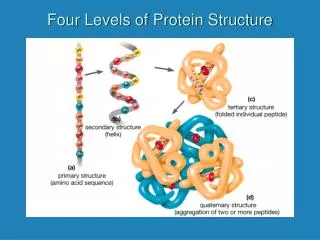
Another example of secondary structures are pleated sheets formed when the polypeptides line up side-by –side, and hydrogen bonding occurs.
Whenever two cysteine units come together, sulfur atoms on their sides form covalent disulfide bonds. Kinked hair have more of these bonds. A strong base can be used to break bonds & straighten hair.
Different proteins lose their biological activity at different temperatures. • For example, the protein controlling the synthesis of the darker colored pigment in Siamese cats is active only in the cooler, peripheral parts of the body, such as the ears, nose, paws, and tip of the tail.
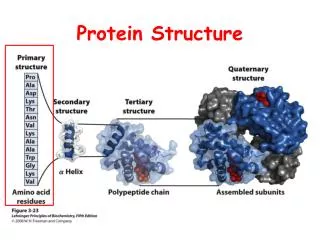
QUATERNARY STRUCTURE: • Proteins such as hemoglobin & insulin have more than one chain combined and are rather large proteins.