Download

1 / 13
140 likes | 312 Views
In this lesson, you'll explore the fundamental structure of nucleotides, the building blocks of nucleic acids. Discover how nucleotides bond to form polynucleotide chains and delve into the intricate structure of DNA. Key components include nitrogenous bases, a phosphate group, and ribose sugar. Learn about base pairing, polymerization, and the critical contributions of scientists like Watson, Crick, Franklin, and Wilkins. By the end, you'll understand how RNA is transcribed from DNA and the unique structure of RNA, including its secondary forms.

E N D
Structure of Nucleic Acids Lesson 1
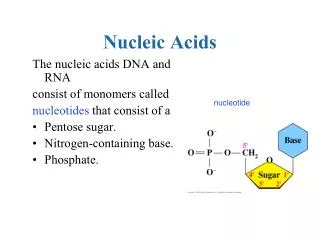
Learning Objectives By the end of the lesson you will:- • be able to describe the structure of a nucleotide. • understand how nucleotides join together to form polynucleotide chains. • be able to describe, with the aid of diagrams, the structure of DNA.
The three components are compiled by condensation reactions that release water.
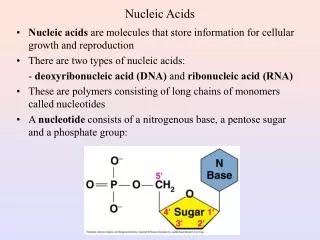
More detailed structure of a nucleotide... Nitrogenous base (Adenine) The nitrogenous base can change. There are four alternatives in DNA. Phosphate group Ribose sugar
Guanine Adenine Purines Cytosine Pyrimadines Thymine In each case, the circled hydrogen is lost when the base attaches to the ribose sugar in the nucleotide.
The 4 possible nitrogenous basesare bonded to the ribose sugar in the following ways (note the pictures of the bases differ from the previous ones only in their orientation)
However, in addition to this, the bases can also bond with each other by hydrogen bonding. Each purine pairs with a pyrimidine which enables nucleotides to lock together.
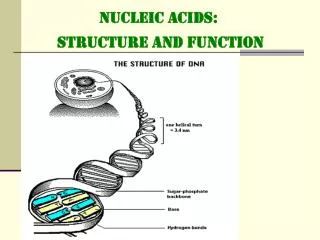
The structure of DNA was worked out by James Watson and Francis Crick working at the Cavendish laboratory in Cambridge. The x-ray diffraction work of Rosalind Franklin and Maurice Wilkins was also fundamental to the identification of the structure of DNA.
Polymerisation of the base nucleotides Creation of linked strands that run opposite (anti-parallel) to one another.
In transcription, RNA strands are copied from one side of the DNA once it has been ‘unzipped’ In RNA, which is single stranded, the thymine base is replaced by uracyl.
Most cellular RNA molecules are single stranded. They may form secondary structures such as stem-loop and hairpin. Figure 3-C-1. Secondary structure of RNA. (a) stem-loop. (b) hairpin