
Understanding Alkanes: The Basics of Hydrocarbons and Their Applications
Alkanes are a family of hydrocarbons characterized by single bonds between carbon atoms, forming chains and non-aromatic rings. Representing the simplest organic molecules, alkanes follow the formula CnH2n+2, where adding a carbon increases hydrogen numbers linearly. Their boiling points rise with size, enabling fractional distillation in refineries. Alkanes are integral to everyday products like natural gas, gasoline, and lubricants. This guide introduces naming conventions and the IUPAC system, essential for understanding and identifying these fundamental compounds.
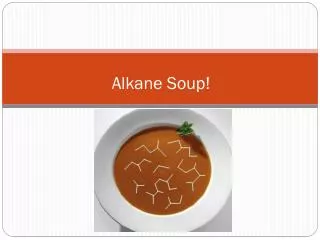

Understanding Alkanes: The Basics of Hydrocarbons and Their Applications
E N D
Presentation Transcript
Hydrocarbons • A molecule containing only carbon and hydrogen atoms. • When we look at molecules, BLACK always means CARBON, and WHITE (and sometimes grey) means HYDROGEN. • Hydrocarbons are the simplest organic molecules
Alkanes • Alkanes are a family of hydrocarbons • All single bonds – carbon is bonded to four other atoms • Alkanes are aliphatic – they form chains and non-aromatic rings (we’ll learn about aromatic molecules later) • Alkanes, like other hydrocarbon chains, form a homologous series • This means that adding a single carbon to the chain increases the number of hydrogens by a definite number • In the case of alkanes, # hydrogens = (2 x # carbons) + 2 • CnH2n+2
Fractional Distillation • Boiling points of alkanes increase with size, so refineries can use this property to separate crude oil into its components • Components: • < 20oC: Small gaseous alkanes, usually further refined or liquefied • 20-100oC: Slightly larger, used as solvents or further refinement • Up to 200oC: Straight-run gasoline – this gets refined and sold as common fuel • Up to 300oC: Large alkanes, used for kerosene and jet fuel • Up to 400oC: Larger alkanes, used as oil and diesel fuel • Remaining unboiled liquids are used as lubricating oils • Solid residues are used for asphalt, tar, and paraffin wax.
Uses of Alkanes • Methane (natural gas) • Butane lighters • Automotive and industrial lubricants • Vaseline (also a lubricant) • Commercial Gasoline (petrol) • Other Fuels (propane tanks) • Tar (used in asphalt) • Candle wax
How do we name them? • So, how did we come to call them methane, propane, butane, octane…? • IUPAC (International Union of Pure and Applied Chemistry) devised a system to name organic molecules • It uses a set of suffixes and prefixes to identify all organic molecules, from the simplest tothe ridiculously complex • It can get quite complex for verylarge molecules, which is whymany compounds still usecommon names
The Name • Think of naming a molecule as just like naming a person: Person: First Name(1) + Middle Names(2) + Family Name(3) Molecule: Branch Prefixes(2) + Root Name (1) + Family Suffixes(3) Alkanes all have the family suffix –ane.
IUPAC Nomenclature • There are lots of rules, but we’re going to learn them as we go. • When identifying a hydrocarbon, first find the longest chain of carbons that are bonded to each other (no breaks in the chain) • The longest chain ISN’T always the one going straight across! 3 8
Root Name • The longest carbon chain is known as the parent chain. The root name tells you how many carbons are in the parent chain. • Each prefix below refers to a number of carbons:
Methane Ethane Propane The First Six Alkanes Butane Hexane Pentane
Practice makes Perfect! • You need to practice naming lots of molecules! • Complete Alkane Worksheet • If you have any questions, make sure you ask me! • Do the following questions: (for homework) • P. 330 (#1, 2, 4) and p. 332 (all 4)