Download
1 / 1
Download Presentation 
Optimizing Detector Alignment and Beam Stability in FPD Measurements
An Image/Link below is provided (as is) to download presentation
Download Policy: Content on the Website is provided to you AS IS for your information and personal use and may not be sold / licensed / shared on other websites without getting consent from its author.
Content is provided to you AS IS for your information and personal use only.
Download presentation by click this link.
While downloading, if for some reason you are not able to download a presentation, the publisher may have deleted the file from their server.
During download, if you can't get a presentation, the file might be deleted by the publisher.
E N D
Presentation Transcript
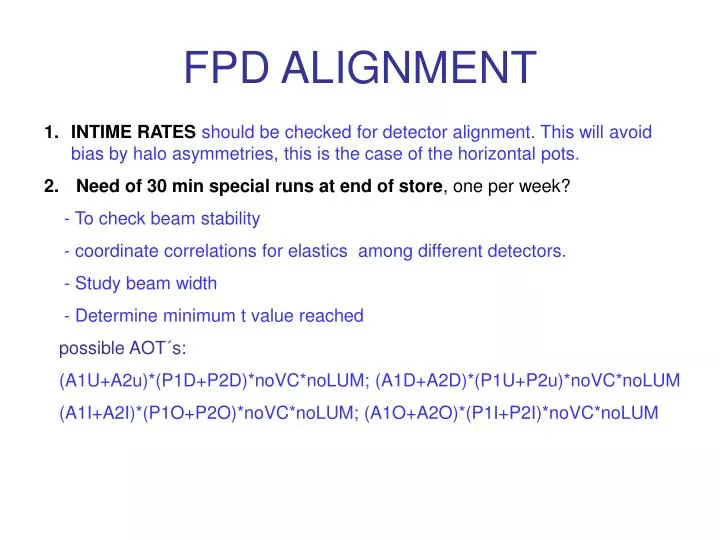
FPD ALIGNMENT • INTIME RATESshould be checked for detector alignment. This will avoid bias by halo asymmetries, this is the case of the horizontal pots. • Need of 30 min special runs at end of store, one per week? • - To check beam stability • - coordinate correlations for elastics among different detectors. • - Study beam width • - Determine minimum t value reached • possible AOT´s: • (A1U+A2u)*(P1D+P2D)*noVC*noLUM; (A1D+A2D)*(P1U+P2u)*noVC*noLUM • (A1I+A2I)*(P1O+P2O)*noVC*noLUM; (A1O+A2O)*(P1I+P2I)*noVC*noLUM











More Related