Download
1 / 4
40 likes | 155 Views
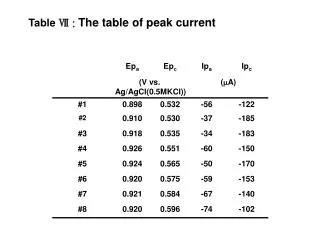
This study presents the cyclic voltammetry results for an Au-Cr coated on silicone wafer working electrode, featuring a surface area of 0.125 cm². The electrode was tested in two different electrolytes - 0.2 M H₂SO₄ and 0.5 M KCl with specific ferrocyanide concentrations. The tests aim to analyze peak currents while varying interference conditions and pH levels, particularly with the presence of albumin. The experiment was conducted at controlled temperatures of 37-38°C, with a scan rate of 0.05 V/sec. Results are summarized in Table VII.

E N D
Fig 2. The renewing test of Au electrode WE: Adsorbed Au-Cr coated on silicone wafer by e-beam, 0.125 cm2, RE: SCE, CE: Pt, Electrolyte: 0.2 M H2SO4, Scan range: -0.20~0.60 V, Scan rate: 0.05 V/sec
Fig 2. The cyclic voltammetry of Au electrode WE: Au-Cr coated on silicone wafer by e-beam, 0.125 cm2, RE: Ag/AgCl(0.5MKCl), CE: Pt, Electrolyte: 0.5 M KCl +20 mM K4Fe(CN)6+20 mM K3Fe(CN)6), Scan range: -0.20~0.60 V, Scan rate: 0.05 V/sec
Table Ⅶ: The table of peak current *normal concentration interference/0.5 MKCl/PH=3.51(1N HCl) *8ppm albumin /0.5MKCl/PH=3.51(1N HCl) *adsorb temperature 37-38℃