Sustainable Management of Hazardous Waste: Strategies and Solutions
210 likes | 320 Views
This resource explores the sustainable management of hazardous waste, emphasizing the need to reduce, reuse, recycle, and safely dispose of these materials. It covers integrated hazardous waste management approaches, highlights case studies like e-waste recycling, and discusses detoxification methods, including bioremediation and phytoremediation. Effective storage solutions and legislative frameworks such as RCRA and CERCLA are also examined. The aim is to foster awareness and inspire actionable solutions for managing hazardous waste responsibly.


Sustainable Management of Hazardous Waste: Strategies and Solutions
E N D
Presentation Transcript
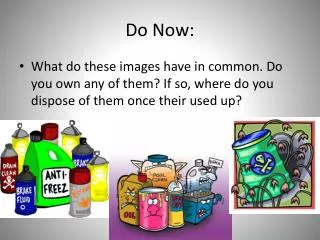
Do Now: • What do these images have in common. Do you own any of them? If so, where do you dispose of them once their used up?
Aim: How Should We Deal with Hazardous Waste? Concept 21-5 A sustainable approach to hazardous waste is first to produce less of it, then to reuse or recycle it, then to convert it to less hazardous materials, and finally, to safely store what is left.
We Can Use Integrated Management of Hazardous Waste • Integrated management of hazardous wastes • Produce less • Convert to less hazardous substances • Rest in long-term safe storage • Increased use for postconsumer hazardous waste
Thumbs Up, Thumbs Down Thumb up – fully understand concept Thumb down – do not understand concept Thumb sideways – are not sure about the concept
Case Study: Recycling E-Waste • 70% goes to China • Hazardous working conditions • Includes child workers • Reduce toxic components in electronics • Dell and HP take recycle their products • Europe has high-tech smelters with strict standards
We Can Detoxify Hazardous Wastes • Collect and then detoxify • Physical methods: Charcoal, resin,precipitating • Chemical methods: cyclodextrin in soils • Use nanomagnets: remove pollutants from water • *Bioremediation: bacteria used to destroy toxins • Phytoremediation: plants as sponges for soil & water • Incineration • Using a plasma arc torch : HIGH TEMPERATURES and ELECTRICAL CURRENT
We Can Store Some Forms of Hazardous Waste • Burial on land or long-term storage • Last resort only but most common. • Deep-well disposal • 64% of hazardous liquid wastes in the U.S.
We Can Store Some Forms of Hazardous Waste • Surface impoundments • Lined ponds or pits • Secure hazardous landfills
Thumbs Up, Thumbs Down Thumb up – fully understand concept Thumb down – do not understand concept Thumb sideways – are not sure about the concept
Leaking Barrels of Toxic Waste at a Superfund Site in the United States
LAWS • RCRA: Resource Conservation and Recovery Act. • 5% of waste is regulated by RCRA • CERCLA: Comprehensive Environmental Response, Compensation, and Liability Act. - Identify sites contaminated by HW and clean them up…aka superfund sites. Super Fund Act: Pay for what they polluted
Summary: • Should the U.S. Congress reinstate the polluter pays principle by levying taxes on chemical, oil, mining, and smelting companies to reestablish a fund for cleaning up existing and new superfund sites? Explain.
Homework: • Complete the Ecological Footprint Analysis on pg. 584-585