Understanding pH and Species Equilibria in Phosphoric Acid and Titration Problems
This quiz assesses your knowledge of the pH of phosphoric acid solutions and their equilibria. You will determine the principal species present at a specific pH (7.50), analyze the second most abundant species, and explore titration concepts involving weak acids. The problems include calculating volumes needed for titration and understanding pH changes during titration. Engage with the equilibrium reactions of H3PO4 and apply your knowledge of pKa values to find the correct answers.

Understanding pH and Species Equilibria in Phosphoric Acid and Titration Problems
E N D
Presentation Transcript
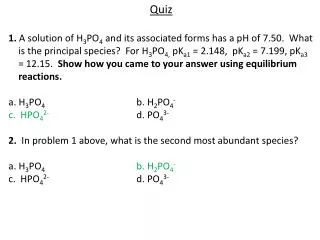
Quiz 1. A solution of H3PO4 and its associated forms has a pH of 7.50. What is the principal species? For H3PO4, pKa1 = 2.148, pKa2 = 7.199, pKa3 = 12.15. Show how you came to your answer using equilibrium reactions. a. H3PO4 b. H2PO4- c. HPO42- d. PO43- 2. In problem 1 above, what is the second most abundant species? a. H3PO4 b. H2PO4- c. HPO42- d. PO43-
Quiz 3. How many mL of 0.250 M HCl need to be added to 20.0 mL of 0.350 M acetate to reach the equivalence point? Show your work. a. 14.0 mL b. 20.0 mL c. 28.0 mL d. none of the above 4. Consider the titration of a weak acid whose pKa is 7.7. What is the pH of the titration half way to the equivalence point? a. 7.7 b. 6.3 c. 7.0 d. more information is necessary