Download
1 / 23
240 likes | 401 Views
This overview explores the origins and developments of the Mongol and Ming Dynasties, detailing the nomadic beginnings of the Mongols, led by the legendary Genghis Khan, their military organization, and their eventual establishment of a vast empire. It examines how Kublai Khan expanded Mongol rule into China and the cultural exchanges that ensued. The rise of the Ming Dynasty under Zhu Yuanzhang, marked by the restoration of Chinese traditions and the end of Mongol dominance, highlights significant agricultural, economic, and societal changes, as well as challenges faced by the Ming rulers.

E N D
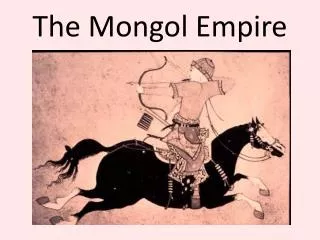
Mongol Origins • Nomadic horse people • N. China Grasslands • Raised horses, tended sheep • Felt tents: Yerts, Ger • Language: Altaic (Rel. To Turkic, Manchurian) • Could not marry between tribes and clans
Organization • Families-->Clans-->Tribes--> • Tribes gathered during annual migration • Chiefs elected. Based on nobility, military ability, wisdom, leadership skills • Religion: Shamanism • Nature deities, but key God is the Sky God • Sacred color: blue
Temujin: Ghengis Khan • b. 1167, son of tribal chief • Father poisoned…fled as youth • Returned as adult, avenged father, Eventually chief • By age forty had unified all Mongol tribes • Battles, alliances, ability to survive • Elected as the Great Khan • Amazing talents along with sons and grandsons
positive aspects of the Mongol conquests • promoted commercial and cultural exchanges global civilizations • stable government based on precedents in • provided lengthy period of peace
Mongol Army Tactics • All males 15-70 served in army • Organized into“Myriads” (10,000’s) • Units within each of 1000, 100, and 10 • Unpaid • Elaborate signals • Soldiers supplied military equipment
Conquest • Intelligence gathering high priority • Foreign experts and advisors • Every man carried own supplies; had 2 horses. • Loyalty oaths • Creation of Yasa, law code
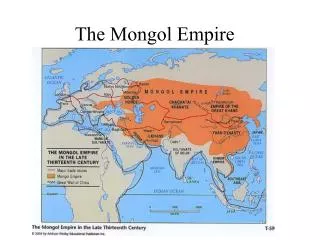
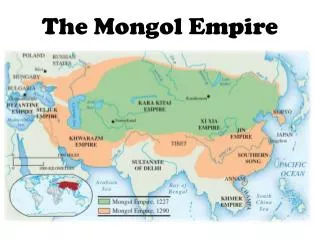
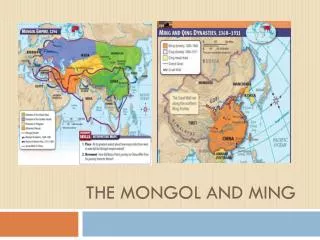
Divisions at Genghis Khan’s Death • Four Khanates • Kipchak Khanate (Golden Hoarde) • Russia • IlKhanate • Persia • Chagatai Khanate • Mongolia • Great Khanate • China, Outer Mongolia, Border States, to which the others owed allegiance. Later became the Yuan Dynasty
China under Mongol Rule • Kublai Khan conquered all of China and defeated the Song. • Ruled from Cambulac (Beijing) • Called himself the Yuan dynasty (1271-1368) • Building Projects • Religious Toleration • Ethnic Ranking • Marco Polo spent 17 years in Kublai’sservice
Decline and succession • Chinese never really accepted as legitimate • Succession wars between heirs and generals • High Taxes, Corrupt officials • Paper money controversy • Yellow River changed course and flooded Grand Canal among other natural disasters • Decentralization & Rise of Warlords • Last Khan fled to Mongolia in 1368 after the Red Turbans Buddhist led revolts
The Ming Restore Chinese Rule • After Kublai Khan’s death, the Chinese despised the foreign Mongol rulers. • Zhu Yuanzhang defeated the Mongols back to the other side of the great wall & began the Ming (brilliant) Dynasty • The Ming ended foreign rule and restored Chinese traditions. • Revival of the arts & better methods of printing which led to a flood of books
China under Ming Rule Rebuilding China • 1368, peasant named Zhu Yuanzhang, rebel army, overthrew last Mongol emperor • Zhu took name Hongwu, “vastly martial,” founded Ming dynasty • Ming means “brilliant”; dynasty lasted nearly 300 years, until 1644 • rulers gained control of Korea, Mongolia, parts of Central, Southeast Asia • worked to rebuild China • Reduced taxes, improved trade, agriculture, increased stability The Ming Dynasty (1368-1644) In addition, Hongwu worked to eliminate Mongol influences and revive traditional Chinese values and practices, like Confucian principles.
Ming Economy and Society • Prosperity • Improved methods of irrigation increased farm production • Peasants produced huge rice crops in southern river valleys • Growth of Crops, Population • 1500s, new crops like corn, sweet potatoes from Americas reached China • crops further increased farm output • Stability, plentiful food led to substantial population growth • Growth of Cities, Industries • As population grew, so did cities • Industries like manufacture of porcelain, silk expanded in response to growing European demand • At same time, China remained mainly agricultural society
Social hierarchy and mobility • scholar-officials, farmers, artisans, and merchants • scholar-official-landlord • learning, political power, and economic wealth • local elite (gentry) and lineage • lack of work ethic • literati’s long gown • foot-binding for women
China’s Tributary System • Traditional system for managing foreign relations • The ``Central Kingdom” worldview • Ming dynasty had the most extensive tributary system • tributes from East Asia, South Asia, Southeast Asia, and even West Asia and Africa
Values, Traditions • To obtain government officials educated in Confucian ideas, Hongwu restored, improved civil service examination system • To root out corruption, increased influence of censors, officials who monitored government • Expanded Power • Hongwu also greatly expanded power as emperor • Did away with positions of some high level officials, took over more control of government • As result, Ming emperors more powerful than in previous dynasties • Eliminated anyone challenging authority; killed thousands of rivals
Yonglo • In 1398 Hongwu died • Following power struggle, son Yonglo became emperor • Ruled from 1402 until 1424 • Moved Ming capital to Beijing, in northeast China • Built vast imperial city at center of Beijing • City complex became known as Forbidden City because most people forbidden from entering
Zheng He’s fleet (1405 - 1433) • Over 300 ships & 20,000 men • trade and commerce • Southeast Asia, South Asia, West Asia, and East Africa
China and the World 1405 – the voyages by Zheng He - to promote trade & collect tribute. • Showed others the power of the Chinese empire. • After he died, sea trading was halted b/c Confucian scholars were loyal to tradition & didn’t want foreign influence. • China missed its opportunity.
Outside Influences • European Influence • Some Europeans gained influence in China • One was Matteo Ricci, Italian Jesuit priest; arrived 1583 • European Learning • Ricci learned Chinese, adopted customs to gain acceptance • Introduced European learning in math, science • Mongol Threat • Ming also faced renewed Mongol threat to north • To improve defense, Ming restored China’s Great Wall • Great Wall • Parts of earlier walls repaired, but most construction new • Much of Great Wall seen today built during Ming period
Ming Foreign Relations Beginning of Isolation • 1500s, move toward isolation gained full force • Ming heavily restricted foreign trade and travel • Foreign merchants allowed to trade only at few ports, during certain times • Policies impossible to enforce; smugglers carried out brisk trade with foreign merchants • Arrival of European traders, Christian missionaries influenced decision to isolate China • Europeans introduced new goods and ideas • Ming disliked European influences • Sought to preserve Chinese traditions Ming Foreign Relations The policy to end the voyages was part of a move in Ming China toward isolation from the outside world.
The Manchu Reasons for Decline • Ming China weakened; the Manchu, a people to northwest in Manchuria, saw their chance • 1644, Manchu swept into Beijing, took capital • Last Ming emperor killed himself to avoid capture • Manchu formed own dynasty; gave it Chinese name—Qing • Late 1500s, Ming Dynasty began to decline • Weak rulers took throne, corruption increased under their rule • Defense efforts drained treasury; rulers raised taxes • 1600s, high taxes, crop failures led to famine, hardship; rebellions broke out Ming Decline