No Assembly line
120 likes | 245 Views
This document explores the dynamics of assembly line production, focusing on the concepts of pipelining and critical path management. It details the five stages of car assembly—from chassis to body—highlighting the advantages of pipelining, such as increased throughput and reduced cycle times. Challenges like start-up waste, stalls due to unexpected problems, and flushes when orders cease are examined. Additionally, the impact of latency and the importance of evenly distributing work across stages are discussed to achieve efficient operations.


No Assembly line
E N D
Presentation Transcript
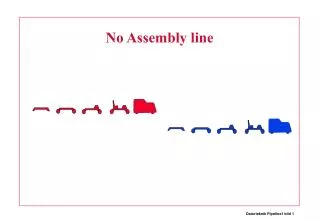
Assembly line - start up 1. 2. 3. 4. 5. Chassis Axels Motor Seats Body Start up waste t
Assembly line - stop 1. 2. 3. 4. 5. Chassis Axels Motor Seats Body Nothing to do
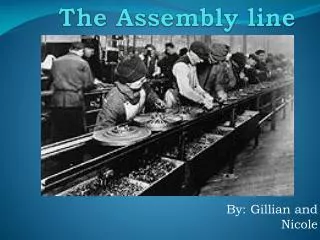
Assembly line • At start: final stations idle • At stop: start stations idle • 5 “stages” for each car • Each car still takes 5 stages but... • ... we produce one car each step
Time-set car Cycles instruction 5 cycles 1 instr. = 5 5 cycles 5 instr. = 1 Assembly line Without pipelining: With pipelining
Pipelining T = Nq * CPI * Tc We can bring this But what down to 1 determines this? The slowest pipeline stage “Rate determining step”
Pipeline is most efficient... ...when the work is equally shared “critical path” delay same for each stage or as close as possible
How do we break up a long critical path? Insert flip - flops!
But - “no free lunch” 30 ns • Delay: 30 ns 10 ns • Latency: 1 cycle 3 cycles • Also: The flip-flops have a cost! 10 ns 10 ns 10 ns
Pipeline problem: • Start-up waste • Unexpected problem in a stage (stall) • No more orders (flush)
Zeroext. = = Branch logic 0 A ALU 4 B + = = 31 + Sgn/Ze extend