Understanding Viruses: Life Cycle, Structure, and Impact on Hosts
Chapter 6 delves into the fascinating world of viruses, highlighting their unique characteristics as obligate intracellular parasites. While viruses are inert outside a host cell, they become active when inside, directing the host to replicate them. The chapter explores the basic structure of viruses, their various morphologies, and the intricate life cycles including lytic and lysogenic phases. It also covers cultivation methods, the role of prions in diseases, and the significance of viruses like HIV and influenza, emphasizing their impact on health and the need for adaptive vaccines.

Understanding Viruses: Life Cycle, Structure, and Impact on Hosts
E N D
Presentation Transcript
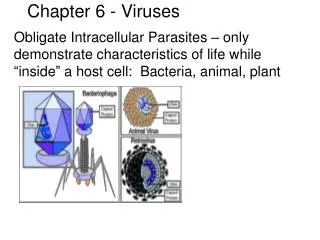
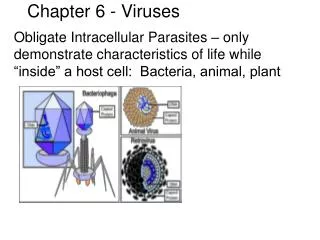
Chapter 6 - Viruses Obligate Intracellular Parasites – only demonstrate characteristics of life while “inside” a host cell: Bacteria, animal, plant
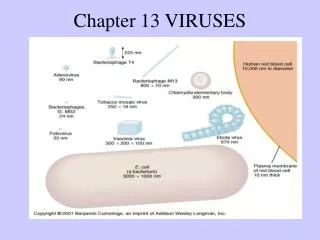
Chapter 6 - Viruses Outside a host cell, inert, no enzyme or other activity Inside a host cell – viral Nucleic Acid (DNA or RNA) takes over the cell and directs the cell to produce new virus particles (replication) Size of Viruses: See page in text 155?, very tiny (picorna) to huge (pox viruses)
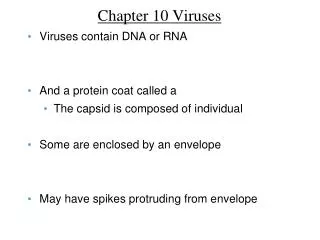
Chapter 6 - Viruses Basic virus particle is called a “virion” – intact and infective virus particle Components: Nucleic Acid (DNA or RNA), Protein coat (capsid) made of individual protein subunits called capsomeres. Some may have and outer envelope, a membrane, derived from the host cell. The envelope can have specific spikes of protein (H and N spikes of Influenza) that aid in attachment and makes them sensitive to chemical actions of disinfectants.
Chapter 6 - Viruses Types of viruses based on “morphology” – shape; structure Helical (like TMV or Ebola) Polyhedral (adeno and polio) Enveloped (flu) and Complex (bacteriophage)
Chapter 6 - Viruses EBOLA
Chapter 6 - Viruses Polio virions
Chapter 6 - Viruses Influenza A: Enveloped, with spikes, RNA, multisegmented genome (8 separate pieces of RNA)
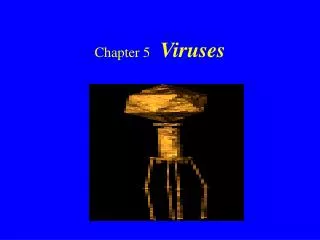
Chapter 6 - Viruses Bacteriophage: Complex
Chapter 6 - Viruses Taxonomy of viruses: complicated and “boring”; we’ll leave it to the ones with a higher “paygrade”
Chapter 6 - Viruses Cultivation of viruses: need living cells, living hosts Tissue cultures, embryonated eggs, bacterial cultures
Chapter 6 - Viruses Cultivation of viruses: need living cells, living hosts Tissue cultures, embryonated eggs, bacterial cultures Bacteria grown as a “lawn” – and viruses are in the clear zones, plaques
Chapter 6 – Viruses: Viral replication in bacteria – life cycle of bacterial virusLYTIC Cycle
Chapter 6 - Viruses Viral replication in bacteria – life cycle of bacterial virus Lysogneic (latent) cycle, genome of virus incorporated into host cell genome “infected with seeds of destruction”
Chapter 6 - Viruses Animal Virus Life Cycle: Penetration, Uncoating, Biosynthesis, Assembly, Maturation, Release Can have Latent infection also.
Chapter 6 - Viruses Animal Virus Life Cycle: Penetration, Uncoating, Biosynthesis, Assembly, Maturation, Release Can have Latent infection also. Latent infection is seen in herpes type and even HIV
Chapter 6 - Viruses Animal Virus Life Cycle: Penetration, Uncoating, Biosynthesis, Assembly, Maturation, Release Can have Latent infection also. Latent infection is seen in herpes type and even HIV Hiv is a RNA virus, a “retrovirus” with an enzyme called reverse transcriptase “ causes DNA to be synthesized from genome that is RNA (backwards) The Drug AZT works on HIV by inhibiting this enzyme
Chapter 6 - Viruses Budding of an animal virus from a host cell
Chapter 6 - Viruses Budding of rabies viruses – electron photomicrograph
Chapter 6 - Viruses Multi-segmented RNA genome of Influenza: higher mutation rate, genetic shift and drift, new vaccines required
Chapter 6 - Viruses Prions: Infectious proteins, cause scrappie in sheep, Kuru in humans, BSE in cattle, and KJD in people (mad cow in humans) Watch the video “The Brain Eaters” Spoingioform encephalopathy