Chapter 10 Viruses
380 likes | 582 Views
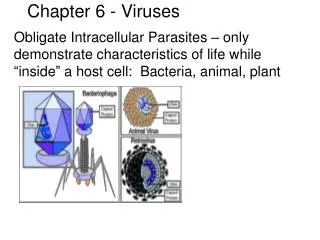
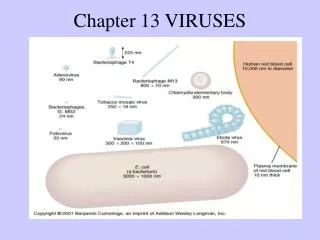
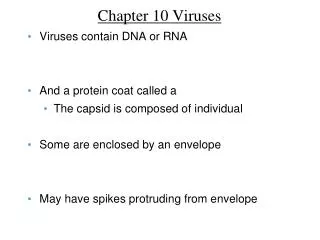
Chapter 10 Viruses. Viruses contain DNA or RNA And a protein coat called a The capsid is composed of individual Some are enclosed by an envelope May have spikes protruding from envelope. Most viruses infect only specific types of cells in one host


Chapter 10 Viruses
E N D
Presentation Transcript
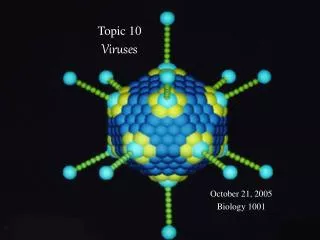
Chapter 10 Viruses • Viruses contain DNA or RNA • And a protein coat called a • The capsid is composed of individual • Some are enclosed by an envelope • May have spikes protruding from envelope
Most viruses infect only specific types of cells in one host • Host range is determined by specific host attachment sites and cellular factors
Helical Viruses Causes systemic infection often with hemorrhagic fever
Viral Taxonomy • Family names end in -viridae • Genus names end in -virus • A group of viruses sharing the same genes and host. Common names are used for species • Subspecies are designated by a number
Viral Taxonomy • Family : Herpesviridae • Genus: Simplexvirus • Species/Subspecies: Human herpes virus 1, HHV 2 • Family: Retroviridae • Genus: Lentivirus • Species/Subspecies: Human Immunodeficiency Virus 1, HIV 2
Growing Animal Viruses • Animal viruses may be grown • in living animals • In embryonated eggs • or in cell culture.
Growing Viruses • Animal (and plant) viruses may be grown in cell culture. • For research purposes • For clinical identification of virus type • By observing
Virus Identification • Some cytopathic effects (not comfirmatory) • Inclusion bodies - rabies virus • Syncytia formation – measles, common cold • Transformation – human papillomavirus
Virus Identification • Serological tests • Detect antibodies against viruses in a patient • Use antibodies to identify viruses • Western blot • Viral nucleic acids: RFLPs (i.e. DNA Fingerprinting), PCR tests
Viral Multiplication • Viruses require host cell “machinery” for replication • Some viruses have some of their own enzymes: mainly for viral nucleic acid replication • Most, if not all, enzymes come from host cell • These enzymes are involved in building new virions
Multiplication of Bacteriophages (Lytic Cycle) • Phage causes lysis and death of host cell • Attachment Phage attaches by tail fibers to host cell • Penetration Phage lysozyme opens cell wall; DNA is then “injected” into cell • Biosynthesis Production of phage DNA and proteins • Maturation Assembly of phage particles • Release Phage lysozyme breaks cell wall
Bacterial cell wall Bacterial chromosome Capsid DNA Capsid Sheath Tail fiber Tail 1 Attachment:Phage attaches to host cell. Base plate Pin Cell wall Plasma membrane 2 Penetration:Phage penetrates host cell and injects its DNA. Sheath contracted Tail core Biosynthesis: phage DNA directs synthesis of viral components by host cell. 3
Tail DNA 4 Maturation:Viral components are assembled into virions. Capsid 5 Release:Host cell lyses and new virions are released. Tail fibers
Specialized Transduction gal gene Bacterial DNA Prophage 1 Prophage exists in galactose-using host (containing the gal gene). Galactose-positive donor cell gal gene 2 Phage genome excises, carrying with it the adjacent gal gene from the host. 3 Phage matures and cell lyses, releasing phage carrying gal gene. gal gene 4 Phage infects a cell that cannot utilize galactose (lacking gal gene). Galactose-negative recipient cell 5 Along with the prophage, the bacterial gal gene becomes integrated into the new host’s DNA. 6 Lysogenic cell can now metabolize galactose. Galactose-positive recombinant cell
Multiplication of Animal viruses • Attachment Viruses attach to cell membrane • Penetration By endocytosis or fusion • Uncoating By viral or host enzymes • Biosynthesis Production of nucleic acid and proteins • Maturation Nucleic acid and capsid proteins assemble • Release By budding (enveloped viruses) or rupture (non-enveloped viruses)
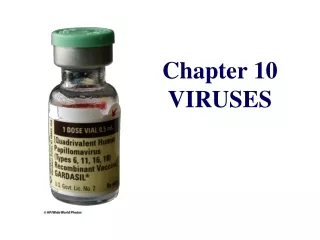
Nonenveloped DNA virus • Can cause cancer (cervical cancer) • Hand warts • Genital warts • Commonly sexually transmitted • Prevention: vaccine for HPV • Respiratory infections in humans • Usually sudden onset and short duration • Tumors in animals
Enveloped DNA virus • Can cause chronic liver disease • Can lead to liver cancer • Body fluid transmisson • Prevention: vaccine • Human Herpes Virus 1 and HHV 2 – “cold sores” and genital herpes • Sexually transmitted • Other direct contact transmission • Prevention: condoms (not 100%), abstinence
Enveloped DNA virus • Varicella-Zoster virus (HHV 3) – • Chicken pox is initial infection • Shingles may occur later • Contracted by inhaling virus • Prevention: vaccine • Epstein-Barr virus (HHV 4) – Infectious Mononucleosis • Saliva transmission • Burkitt’s lymphoma in African children • Prevention: avoid infected body fluids (mainly saliva)
Multiplication of a Retrovirus Capsid Reverse transcriptase Envelope Virus Two identical strands of RNA 1 Retrovirus penetrates host cell. Host cell DNA of one of the host cell’s chromosomes 5 Mature retrovirus leaves host cell, acquiring an envelope as it buds out. Reverse transcriptase 2 Its RNA is uncoated; reverse transcription takes place. Viral RNA Identical strands of RNA 4 Transcription of the provirus may also occur, producing RNA for new retrovirus genomes and RNA that codes for the retrovirus capsid and envelope proteins. Viral proteins RNA 3 The new viral DNA is tranported into the host cell’s nucleus and integrated as a provirus. The provirus may divide indefinitely with the host cell DNA. Provirus
Retroviruses – enveloped RNA viruses • Use reverse transcriptase to produce DNA from RNA viral genome • HIV - AIDS • Oncogenic viruses • Some retroviruses can cause cancer
Cancer • The genetic material of oncogenic viruses becomes integrated into the host cell's DNA. • “transform” normal cells into cancerous cells. • An oncovirus can promote oncogene expression • may contain oncogenes
Viral Infections • Virus remains in host cell for long periods, asymptomatically • Subsequent activation may lead to: i.e. cold sores, shingles • Persistent Viral Infections • Disease progresses over a long period, generally fatal • Subacute sclerosing panencephalitis, SSPE (measles virus) • AIDS dementia complex (HIV)
Prions • Infectious proteins • Inherited, and transmissible by ingestion, transplant, & surgical instruments • Spongiform encephalopathies (fatal): Sheep Scrapie, Creutzfeldt-Jakob disease, mad cow disease • Cause: • normal cellular prion protein on cell surface, • converts to • scrapie protein, accumulates in brain cells forming plaques
Prions PrPSc PrPc 2 3 4 1 Lysosome Endosome 5 6 7 8
Plant viruses and viroids • Plant Viruses • enter through wounds or via insects • are infectious RNA • One causes potato spindle tuber disease Potato Spindle Tuber Viroids
RNA virus, nonenveloped • Poliovirus • May be paralytic in ~1% of cases • Transmission: • Prevention: vaccine • Human • Number one cause of the common cold • Attacks liver, kidneys, spleen • Transmission: fecal-oral route • Usually not fatal • Prevention: vaccine (long-term), immune globulin (short-term)
RNA virus, enveloped • Influenza viruses A, B, and C • Type A have caused • Both type A and B cause seasonal flu • Subtypes differ based on H and N spike variation
Influenza viruses continued: • Mutation of H and N spike can lead to epidemics or pandemics • Contracted by inhaling virus • Prevention: vaccine may prevent
RNA virus, enveloped • Infects birds and humans • Transmitted by mosquitos • First appeared in U.S. in 1999 in NYC area; now coast to coast • Symptoms: Usually “flu-like;” less than 1% get West Nile Encephalitis • Prevention: avoid mosquito bites