Robust Query Processing Through Progressive Optimization: Enhancing Database Performance
This paper presents a novel approach to query optimization, addressing the limitations of traditional optimizers that heavily rely on cardinality estimations, which can lead to errors due to inaccurate statistics and invalid assumptions. We introduce Progressive Query Optimization (POP) and the concept of CHECK, exploring its variants and applications. The architecture of POP allows for efficient evaluation of query execution plans through validity ranges without pre-enumerating all optimal plans. Our performance analysis demonstrates the robustness of POP in real-world scenarios, balancing risk and opportunity in query execution.

Robust Query Processing Through Progressive Optimization: Enhancing Database Performance
E N D
Presentation Transcript
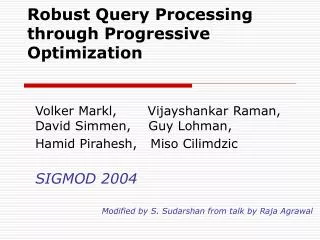
Robust Query Processing through Progressive Optimization Appeared in SIGMOD 2004 Volker Markl, Vijayshankar Raman, David Simmen, Guy Lohman, Hamid Pirahesh, Miso Cilimdzic raja@cse.iitb.ac.in
Motivation • Current optimizers depend heavily upon the cardinality estimations • What if there errors in those estimations? • Errors can occur due to … • Inaccurate statistics • Invalid assumptions (e.g. attribute independence)
Overview of talk … • What's this all about • Contribution of the paper • Related work • Progressive Query Optimization(POP) • CHECK and its variants • Performance analysis • A real-world experiment results
Contribution • Concept of CHECK and its various flavors • Method for determining validity ranges for QEPs • Performance analysis of prototype of POP
Evaluating a re-optimization scheme • Risk Vs Opportunity • Risk: • Extent to which re-optimization is not worthwhile • Opportunity: • Refers to the aggressiveness
Background • KD98 • Tukwila • Telegraph • Parametric optimization
Architecture of POP • Find out valid ranges • Location of CHECKs • Executing CHECKs • Interpret CHECK • Exploit intermediate results
Computation on Validity Ranges • Validity range: is an upper and lower bound which when violated, guarantees that the current plan is sub-optimal wrt to the optimizers cost model • No need to enumerate all possible optimal plans beforehand • Uses modified Newton-Raphson method to find validity ranges
Exploiting Intermediate Results • All the intermediate results are stored as temporary MVs • Not necessarily written out to disk • In the end, all these temporary MVs needs to be deleted (extra overhead?)
Variants of CHECK • Lazy checking • Lazy checking with eager materialization • Eager checking without compensation • Eager checking with buffering • Eager checking with deferred compensation
Variants of CHECK (contd.) • LC: • Adding CHECKs above a materialization point (SORT, TEMP etc) • As, no results have been output yet • And materialized results can be re-used • LCEM: • Insert materialization point if it does not exists already • Typically done only for nested-loop join
Eager Checking (EC) • EC without Compensation: • CHECK is pushed down the MP • EC with buffering • CHECK and buffer
Eager Checking with pipelining • EC with Deferred Compensation • Only SPJ queries • Identifier of all rows returned to the user are stored in a table S, which is used later in the new plan for anti-join with the new-result stream
CHECK Placement • LCEM and ECB – outer side of nested-loop join • LC – above materialization points • ECWC and ECDC – anywhere
Performance Analysis • Robustness
Performance Analysis cont … • Risk Analysis
POP in (in)action • 22 Vs 17
POP in (in)action (contd.) • Re-optimization may result in the choice of worse plan due to: • Two estimation errors canceling out each other • Re-using intermediate results
Conclusions • POP gives us a robust mechanism for re-optimization through inserting of CHECK (in its various flavors) • Higher opportunity at low risk
Future work • Lets decide