Download
1 / 1
10 likes | 132 Views
DIETETICS. 2014/15 pan-London planned commissioning position: maintain commissions at 76 Planning for t his profession is led by Health Education South London for the whole of London. Existing and raised issues An oversupply was reported in 2011 and 2012.

E N D
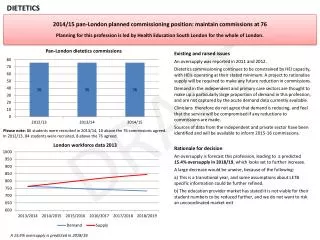
DIETETICS 2014/15 pan-London plannedcommissioning position: maintain commissions at 76 Planning for this profession is led by Health Education South London for the whole of London. Existing and raised issues An oversupply was reported in 2011 and 2012. Dietetics commissioning continues to be constrained by HEI capacity, with HEIs operating at their stated minimum. A project to rationalise supply will be required to make any future reduction in commissions. Demand in the independent and primary care sectors are thought to make up a particularly large proportion of demand in this profession, and are not captured by the acute demand data currently available. Clinicians therefore do not agree that demand is reducing, and feel that the service will be compromised if any reductions to commissions are made. Sources of data from the independent and private sector have been identified and will be available to inform 2015-16 commissions. Please note: 86 students were recruited in 2013/14, 10 above the 76 commissions agreed. In 2012/13. 84 students were recruited, 8 above the 76 agreed. London workforce data 2013 • Rationale for decision • An oversupply is forecast this profession, leading to a predicted 15.4% oversupply in 2018/19, which looks set to further increase. • A large decrease would be unwise, because of the following: • a) This is a transitional year, and some assumptions about LETB specific information could be further refined. • b) The education provider market has stated it is not viable for their student numbers to be reduced further, and we do not want to risk an uncoordinated market exit A 15.4% oversupply is predicted in 2018/19.