Download
1 / 29
290 likes | 396 Views
Explore the foundational aspects of strength training through this comprehensive guide covering safety practices, exercise techniques, and program design considerations. Learn the principles of resistance training, exercise selection, periodization, and more to enhance your training routines effectively.

E N D
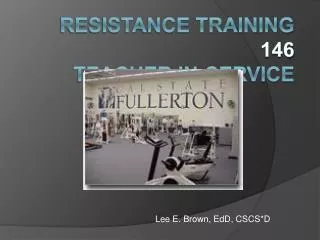
Lee E. Brown, EdD, CSCS*D RESISTANCE Training 146Teacher In-Service
Introduction to Strength Training • Understand physiological foundation • Safety • Technique • Modes and actions of exercise • Program design
Testing • 1RM • Large muscle groups only • Involves technique • 5 or 10RM • Estimate 1RM • Less stressful • Correlation • Handgrip
Exercise Selection • Modes • Isotonic • Isometric • Elastic • Actions • Concentric-shorten • Eccentric-lengthen • Isometric-no change
Spotting • None with machines • None with overhead lifts • None with Olympic lifts • From behind on free weights • Safety first!
Specificity • Individual exercises for goal • Work multi-joint • Know muscles • Know why?
Periodization • Vary the program • Change exercises and volume • Change intensity • Undulate the program monthly
Progressive Overload • Gentle increases • Specific adaptation to imposed demands • Overload for goal of training
General to Specific • Start with large muscle groups • Start with multi-joint • End with single joints • Small muscles last
Simple to Complex • Exercises (not daily routine) • Learn simple exercises first • Teach advanced after training age increases • Machines to free weights
Exercise Selection • Core exercises first • Assistance exercises last
Frequency • 2 to 3 times per week • Increase with training • Split routines • Vary body parts
Intensity (Load) • 60%-85% • Begin low and increase • Choose relative to goals
Repetitions • 2-15 reps • Load and reps are inversely related • Load increases-reps decrease • Decrease reps as program increases
Volume • Sets x reps • Multiple vs. single sets • Begin with single and move to multiple • Anything works with beginners
Super Sets • Agonist then antagonist • Saves rest time • Speeds workout • May decrease load • Push/pull
Rest • Energy systems • 1:1 to 5:1 • Increase rest with load • Begin short and increase to long • Load will determine rest
Velocity • Slow and controlled for strength • 2-4 seconds each action • Super slow does not work • Super fast is too much momentum • Explosive for Olympic only
Breathing • In and out • In during eccentric • Out during concentric • Does not matter as long as breathing • Must do valsalva for 1RM
Children and Adolescents • Lots of attention • 8-12 reps • 2-3 sets • Lots of rest • Major muscle groups
Older Adults • Lots of teaching • 8-15 reps • 2-3 sets • Lots of rest • Major muscles • Functional
Gender • Females are not just small males • No difference in program design • Females lack testosterone • Females lack hypertrophy • Lower relative resistance • Females 65% strength of males
Age • Maturational age • Chronological age • Training age
Form over Function • No bad exercises! • Only contraindicated exercises • Bad form on exercises
Machines vs. Free Weights • Machines easy to start • Machines teach technique • Machines don’t use balance • Free weights use accessory muscles • Free weights are advanced • Should teach both to everyone
DOMS • Delayed onset muscle soreness • Eccentric actions • Peaks at 48-72 hours • Will resolve after few training sessions
Weight Room • Supervision • Safety • Teach why • Test
Syllabus • Download from my web page • Use as generic template • http://faculty.fullerton.edu/leebrown/