Download
1 / 19
190 likes | 288 Views
Discover the essentials of a balanced diet with the Food Pyramid Guide. Learn about various food groups, including grains, vegetables, fruits, fats, dairy, and proteins. This module will help you identify local food examples, understand daily recommendations, and create your personalized Food Pyramid. Engage in fun recipes and learn how to prepare balanced meals that meet your daily nutritional needs. Get ready for an exciting journey toward healthier eating and a better lifestyle!

E N D
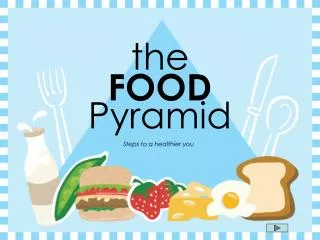
FOOD the Pyramid Steps to a healthier you
Important Instructions • To get the most out of this lesson please be aware of the following navigational directions. • Click on the forward and backward buttons navigate • If you click on a link, please use your brower’s BACK button to return to the presentation. • Depending on your brower, you may be asked to “open” or “save” the presentation each time you click BACK. Click on Open. • If you are asked by angelfire.com to enter a password just click CANCEL.
Eating Right Every Day • Objectives: • Identify food group categories and create a food pyramid • Identify examples from each category that are plentiful in your area • Learn the recommend daily about for each category • Try out some fun recipes • Determine a balanced meal and create your own meal • Learn more about food groups
The Food PyramidSteps to a healthier you • Click here to create your own Food Pyramid GRAINS VEGETABLES FRUITS FATS/OILS MILK MEAT & BEANS Click on each color to determine its category of the food pyramid
GrainsMake half of your grains whole • Different grains grow in different parts of the country. Click on the grains are plentiful in your area. oats rye corn barley wheat rice
How Much Grain Should I Eat?Make half of your grains whole • GRAIN FOODS (based on an ounce equivalent which equals): • 1 piece of bread • 1/2 cup of cooked cereal, like oatmeal • 1/2 cup of rice or pasta • 1 cup of cold cereal • * 4- to 8-year-olds need 4-5 ounce equivalents each day.* 9- to 13-year-old girls need 5 ounce equivalents each day.* 9- to 13-year-old boys need 6 ounce equivalents each day. Try these grainy recipes from kidshealth.org Southern-Style Cornbread Crunchy Munchy Granola Fabulous French Toast
VegetablesVary your veggies • Different vegetables grow in different parts of the country. Click on the vegetable name are plentiful in your area. corn potatoes onions peppers Broccoli, peas, carrots, & mushrooms Zuchini/squash
How many vegetables should I eat?Vary your veggies • VEGETABLES (servings are measured in cups): • * 4- to 8-year-olds need 1 1/2 cups of veggies each day.* 9- to 13-year-old girls need 2 cups of veggies each day.* 9- to 13-year-old boys need 2 1/2 cups of veggies each day. Try these great veggies recipes from kidshealth.org Ants on a Log Incredible Edible Veggie Bowls Tiny Pizzas
FruitsFocus on fruits • Click on the fruits that are plentiful in your area. Kiwi fruit Peaches & nectarines strawberries lemons apples & pears grapes cherries
How many fruits should I eat?Focus on fruits • FRUITS (servings are measured in cups): • * 4- to 8-year-olds need 1-1 1/2 cups of fruit each day.* 9- to 13-year-old girls need 1 1/2 cups of fruit each day.* 9- to 13-year-old boys need 1 1/2 cups of fruit each day. Here is a yummy recipe for Fruit Kabobs! Fun Fruit Kabobs Berry Tasty Muffins Perfect Peachy Freeze
FatsKnow your fats • Below are some examples of common sources of fats. Butter/margarine Beef Nuts
Fat facts-- good and badKnow your fats • Good reasons for fats • Little children need some fat in their diets to promote brain and nervous system development • Fats fuel the body and help absorb some vitamins • Types of fats • Unsaturated fats (good - heart healthy) • Saturated fats (too much is bad) • Trans fats: (too much is bad) • How much do kids needs? • Kids 6-8 need about 48-60 grams per day • Kids 9-12 need about 60-75 grams per day
Milk and DairyGet your calcium rich foods • Click on the dairy products that you enjoy. Milk Ice Cream Yogurt Cheese
How much dairy products should I have?Get your calcium rich foods • MILK and OTHER CALCIUM RICH FOODS: • 4- to 8-year-olds need 1-2 cups of milk (or another calcium-rich food) each day. • 9- to 13-year-old girls need 3 cups of milk (or another calcium-rich food) each day. • 9- to 13-year-old boys need 3 cups of milk (or another calcium-rich food) each day. • If you want something other than milk, you can substitute yogurt, cheese, or calcium-fortified orange juice - just to name a few. Try these nutritional receipes from kidshealth.org Strawberry Smoothie Frozen Yogurt Pops Tomato and Cheese Omelet
Meat and BeansGo lean on protein • Click on the meat and bean products that are plentiful in your area. Pork Chicken & eggs Beef Beans Fish
How much meat and beans do I need?Go lean on protein • MEATS, BEANS, FISH and NUTS (servings measured in ounce equivalents which would be): • 1 ounce of meat, poultry, or fish • 1/4 cup cooked dry beans • 1 egg • 1 tablespoon of peanut butter • a small handful of nuts or seeds • * 4- to 8-year-olds need 3-4 ounce equivalents each day.* 9- to 13-year-old girls need 5 ounce equivalents each day.* 9- to 13-year-old boys need 5 ounce equivalents each day. Protein recipes from kidshealth.org Sausage Meatballs Peanut Butter Muffins Baked Beans
H20 Helps You Grow • Did you know that over half your body is made up of water? • How much water do you think children and adults should drink every day? Click below to find out if you are correct. Children Adults 5 glasses 6-8 glasses
Eat Well and Stay Healthy! • Now you know what is good and bad to eat. Click on the links to test what you learned while having some fun! • Make a balanced meal. • Use the daily food log to record your meals for a week. • Click to create your own meal. • Click here to test your knowledge.
ResourcesIf you want to learn more http://www.vitamix.com/household/health/pyramid.html?ac=ggl&msg=MyPy http://www.coolmeals.co.uk/index.html The Food Guide Pyramid. Retrieved November 10, 2006 from http://www.kidshealth.org/kid/nutrition/food/pyramid.html Food Servings Summary Thank you – close this window to return to the website