Advancing Silicon Nanophotonics for Enhanced Biosensing Applications
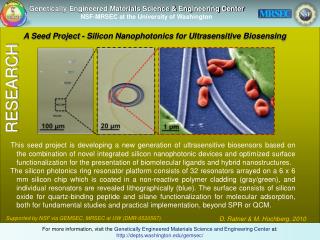
This seed project aims to develop groundbreaking ultrasensitive biosensors by integrating novel silicon nanophotonic devices with optimized surface functionalization for biomolecular interaction. Utilizing a silicon photonics ring resonator platform featuring 32 resonators arranged on a compact silicon chip, we employ advanced materials for enhanced sensor performance. This project explores fundamental biomolecular studies and practical applications, going beyond traditional methods like SPR or QCM. Supported by the NSF through GEMSEC at the University of Washington, the research combines cutting-edge technology and material science.

Advancing Silicon Nanophotonics for Enhanced Biosensing Applications
E N D
Presentation Transcript
Genetically Engineered Materials Science & Engineering Center NSF-MRSEC at the University of Washington A Seed Project - Silicon Nanophotonics for Ultrasensitive Biosensing RESEARCH This seed project is developing a new generation of ultrasensitive biosensors based on the combination of novel integrated silicon nanophotonic devices and optimized surface functionalization for the presentation of biomolecular ligands and hybrid nanostructures. The silicon photonics ring resonator platform consists of 32 resonators arrayed on a 6 x 6 mm silicon chip which is coated in a non-reactive polymer cladding (gray/green), and individual resonators are revealed lithographically (blue). The surface consists of silicon oxide for quartz-binding peptide and silane functionalization for molecular adsorption, both for fundamental studies and practical implementation, beyond SPR or QCM. Supported by NSF via GEMSEC, MRSEC at UW (DMR-0520567). D. Ratner & M. Hochberg, 2010 For more information, visit the Genetically Engineered Materials Science and Engineering Center at: http://depts.washington.edu/gemsec/