Discovering Missing Measures in Similar Figures
180 likes | 279 Views
Explore how to find missing side lengths and angles in similar triangles, solve transformations, and identify similarity transformations. Practice problems included.


Discovering Missing Measures in Similar Figures
E N D
Presentation Transcript
Missing Measures in Similar Figures The two triangles are similar. Find the missing side lengths and the missing angles. B E 70o 100 cm 90 cm 200 cm 180 cm 50o A C D F 111 cm
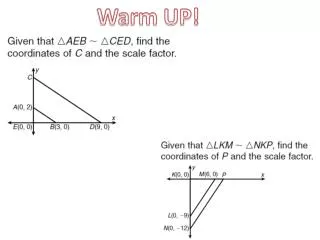
The two triangles are similar. Find the missing side lengths and the missing angle measures. 104 cm B K 60 cm 120 cm A 65o G 45o 50 cm C L
These two triangles are similar. 1. Find the missing length x. 2. Find the measure of < J. 3. Find the missing length y. 4. Find the measure of < P. 5. Susan is making a wood deck from plans for an 8 ft by 10 ft deck. However, she is going to increase its size proportionally. If the length is to be 15 ft, what will the width be? 30 in. 36.9° 4 in. 90° 12 ft
Activator On the following few slides, you will see a series of different transformations. Determine each transformation based on the images. Reflections Glide Reflections Translations Rotations Basic Transformations
Instruction Key Concepts • Two figures are similar if and only if there is a similarity transformation that maps one figure onto the other. • Rigid Motions: Glide reflections, reflections, translations, and rotations are the only four rigid motions (isometries) in a plane. Notation • The notation for the different transformations is as follows: • Reflections Raxis/line • Rotations rdegree/direction • Translations T<x,y> • Dilations Dk
Indicate the transformed coordinate for (3,-5) according to the given notation: • D0.5 = (1.5, -2.5) • Ry-axis = (-x, y) = (-3, -5) • R270CCW = (y,-x) = (-5, -3) • T<2,-4> = (3 + 2, -4 – 5) = (5,-9) • T<-10,7> & D2 = (-7,2) -> (-14,4) This last problem is an example of a similarity transformation
Instruction Example Problem #1 ΔDEF has vertices D(2, 0), E(1, 4), and F(4, 2). What is the image of ΔDEF when you apply the composition ?
Instruction Example Problem #2 What is a composition of rigid motions and a dilation that maps ΔRST to ΔPYZ?
Instruction Are these figures similar? Explain.
Instruction Is there a similarity transformation that maps ΔJKL to ΔRST? If so, identify the similarity transformation.
Instruction • What is the similarity transformation of the following image?
Instruction Make a list of the transformations using the correct notation.
Practice • Flip over to the back of the task from earlier. Complete all the problems