Understanding Decimal Multiplication and Real-Life Applications in Shopping
In this lesson, students will explore the multiplication of decimals through various practical applications. They will solve word problems involving costs, such as determining the total price for multiple items, factoring in sales tax, and applying estimation techniques for reasonableness. Additionally, an engaging partner activity using dice will enhance their skills in multiplying decimals in a fun competition. Homework will reinforce the concepts learned, focusing on decimal multiplication in everyday situations, such as nutrition labels and travel calculations.

Understanding Decimal Multiplication and Real-Life Applications in Shopping
E N D
Presentation Transcript
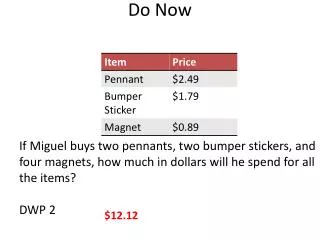
Do Now If Miguel buys two pennants, two bumper stickers, and four magnets, how much in dollars will he spend for all the items? DWP 2 $12.12
To multiply decimals by decimals, lasso the decimals until the end. Then plug in to the final product.
4.2 × 6.7 2) 3.6 × 0.05 3) 0.014 × 3.7 0.18 28.14 0.0518
Partner work: “Dice activity” • Roll each dice. Create a decimal. Roll again. Create another decimal. Multiply and record your answer. • Partner- check your opponents work! • The partner with the largest product at the end of activity wins match.
Let’s Go Shopping! • Pick an item you would love to have. • Research the cost of that item. • Then figure out how much it would cost to buy with a 7% sales tax (7% = 0.07) • With a 12% sales tax (0.12) • With a 14.5% sales tax (0.145)
A certain car can travel 28.45 miles with one gallon of gasoline. The gasoline tank can hold 11.5 gallons. How many miles can this car travel on a full tank of gas? • A nutrition label indicates that one serving of apple crisp oatmeal has 2.5 grams of fat. How many grams of fat are there in 3.75 servings? • 4.8 × 3.2 4) 5.81 × 4 .2 327.175 miles 9.375 g 24.402 15.36
Homework • Pg. 39 #1-40 Evens