Using Equilibrium Data
This article provides an overview of the equilibrium constant (Kc) in chemical reactions, specifically in the context of Le Chatelier's principle. It discusses how Kc is defined as the ratio of the concentrations of products to reactants at equilibrium, its dependence on temperature, and how to calculate Kc values for various reactions. Additionally, it explains the significance of Kc in predicting changes in reaction conditions and determining the position of equilibrium, thereby guiding industries in optimizing chemical processes for better yield.

Using Equilibrium Data
E N D
Presentation Transcript
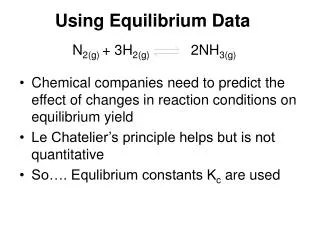
Using Equilibrium Data N2(g) + 3H2(g) 2NH3(g) • Chemical companies need to predict the effect of changes in reaction conditions on equilibrium yield • Le Chatelier’s principle helps but is not quantitative • So…. Equlibrium constants Kc are used
The Equilibrium Constant Kc • At equilibrium the ratio of the concentrations stays constant • If we know the concentrations of the various substances we can calculate the value of the constant • The equilibrium constant Kc is the ratio of concentrations of the reactants and products.
The Equilibrium Constant Kc The general equation for any homogeneous reaction at equilibrium is… aA + bB cC + dD Product concentrations Kc = [C]c [D]d [A]a [B]b Reactant concentrations [ ] represents the equilibrium concentration in moldm-3 a,b,c & d are the numbers of moles of substances A, B, C & D
Units of Kc • The units of Kc depend on the number of moles in the chemical equation. • Units can be calculated by substituting the units for concentration, mol dm-3 into the equation for Kc
Kc Expressions & Units N2(g) + 3H2(g) 2NH3(g) Kc = [NH3]2 [N2][H2]3 Kc = [moldm-3]2 [moldm-3][moldm-3]3 Kc = 1 [moldm-3]2 = mol-2dm6
Kc Expressions & Units 2SO2(g) + O2(g) 2SO3(g) Kc = [SO3]2 [SO2]2 [O2] Kc = [moldm-3]2 [moldm-3]2 [moldm-3] Kc = 1 moldm-3 = mol-1dm3
Kc Expressions & Units CH3COOH (aq) + CH3CH2OH(aq) CH3COOCH2CH3(ag) + H2O(l) Kc = [CH3COOCH2CH3] [H2O] [CH3COOH ][CH3CH2OH] Kc = [moldm-3] [moldm-3] [moldm-3][moldm-3] Kc no units
Calculating Kc values • Every equilibrium has its own Kc • The value of Kc is constant for a particular reaction at a particular temperature • Kc values for different reactions can be calculated experimentally by finding the concentrations of the substances at equilibria.
Calculating Kc values CH3COOH (aq) + CH3CH2OH(aq) CH3COOCH2CH3(ag) + H2O(l) Kc = [CH3COOCH2CH3] [H2O] [CH3COOH ][CH3CH2OH] Kc = 0.67 x 0.67 0.33 x 0.33 Kc = 4.12
Using The Equilibrium Constant Kc • Kc can be used: • To provide a quantitative measure of the extent of a reaction • To determine the position of equilibrium • To calculate the effect of changing concentrations • In general, if the position of the equilibrium lies well over to the product side Kc will be large • A small equilibrium constant indicates that the position of the equilibrium lies well over to the side of the reactants and not much conversion to products takes place.
Kc Expressions N2(g) + 3H2(g) 2NH3(g) Kc = [NH3]2 [N2][H2]3 Kc = 3.0 x 10⁻² mol-2dm6 at 600K Small Kc indicates low yield of NH3