Download
1 / 15
160 likes | 319 Views
This document outlines the Flight Computer (FC) design implemented on the Gumstix Overo Fire, detailing both hardware and software architectures. It explores state estimation methodologies, focusing on indirect measurement of 15 states using a Vicon motion capture system. Key insights include the estimation of attitude through Kalman Filters and the necessity for filtering accelerometer data to improve accuracy. Acceptance testing outcomes highlight the challenges faced, such as operating system overhead and the complexities in visual control design.

E N D
Flight Computer (FC) Liam O’Sullivan - 06308627
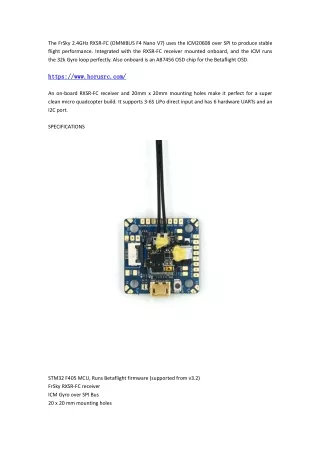
FC Design (Hardware) • Implemented on the Gumstix Overo Fire Overo Fire
FC Design (Software Architecture) Use this text format... FC Software Architecture
State Estimation (SE) Liam O’Sullivan - 06308627
SE Design 15 states to be measured * indirect measurement
SE Design (Position and Velocity) Vicon motion capture system • External motion capture system • Measures object translation and rotation with sub mm accuracy • 200Hz update rate • Ethernet connection (via GCS) • Located at the ARCAA building Vicon IR camera
SE Design (Attitude) Attitude estimated by 3 Kalman Filters (KF) • 1 KF for each Euler angle • IMU rate data (Time Update) • IMU acc data (Measurement Update) • Compass data (Ψ Measurement Update)
SE Design (Attitude) • Example: Estimating φ via KF
SE Testing Outcomes (Attitude) • IMU mounting error in both φ (-1.4°) and θ (-1.2°)
SE Testing Outcomes (Attitude) • Accelerometer low pass filtering
Lessons Learnt Flight computer • Too much operating system overhead State estimation • Accelerometer data needs filtering • Ψ requires KF bound checking • Difficult to design visual control within a year (without a platform)