Counter Reformation
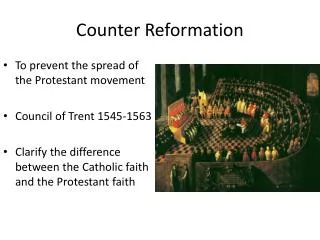
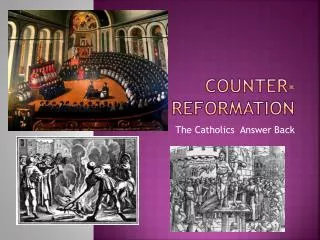
The Council of Trent (1545-1573), called by Pope Paul III, aimed to counter the Protestant Reformation, address internal abuses within the Roman Catholic Church, and reaffirm Catholic doctrine. Key actions included the establishment of the Index of Prohibited Books and the Inquisition, which sought to root out heresy. The Society of Jesus, founded by Ignatius of Loyola, played a significant role in reviving Catholicism across Europe and beyond. While some reforms were successful in curbing corruption and fostering education, the Council also deepened religious divisions, leading to significant conflicts and a loss of state power for the Church.
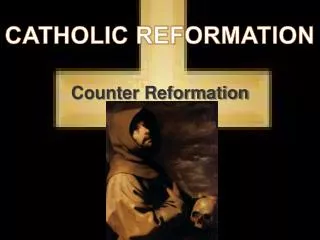

Counter Reformation
E N D
Presentation Transcript
CATHOLIC REFORMATION Counter Reformation
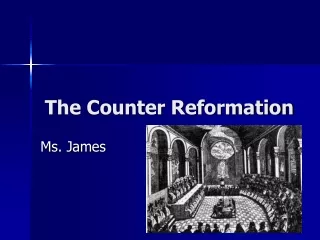
THE COUNCIL OF TRENT • Called by Pope Paul III (1534-1549) • 1545-1573 • Three-fold purpose • Stop the spread of Protestantism • Stop the abuses within the RCC • Reaffirm Church Doctrine
Spread of Protestantism • Index of Prohibited Books • Inquisition – 13th century established to uncover heretics • Heresy – tortured to secure confessions • Unrepentant – handed over to civil authorities = death
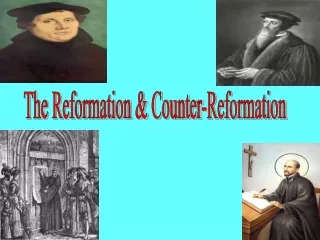
THE SOCIETY OF JESUS • Jesuits • Ignatius of Loyola • 1548 –Spiritual Exercises • Spiritual leader who fought Protestantism – preserved Catholicism in Germany, Poland, and Belgium • New converts – India, China, Japan, and North America
SUCCESS? / FAILURE? • Stopped the sale of indulgences, pluralism, clerical absenteeism, concubines of women • Established seminary for education and training of priests • Veneration of Saints and the Cult of Virgin Mary continued • Individual interpretation of scripture denied
SUCCESS? / FAILURE • Strong leadership from a succession of Popes continued reform • Religious unity destroyed • Religious Wars • State gained power at the expense of the Church • Encouraged education