Design and Implementation of ASKAP Central Processor: Calibration and Imaging Workshop Insights
This workshop, held from March 3rd to 7th, 2014, focused on the design and implementation of the ASKAP Central Processor at the Murchison Radio Observatory in Western Australia. With 36 antennas capable of observing between 0.7 and 1.8 GHz, ASKAP processes staggering data rates of approximately 2.5GB/s. The session highlighted the technical achievements, including supercomputing at the Pawsey Centre, challenges in calibration, imaging pipelines, and the lessons learned from past experiences. Presenters included Ben Humphreys, an ASKAP Computing Project Engineer.

Design and Implementation of ASKAP Central Processor: Calibration and Imaging Workshop Insights
E N D
Presentation Transcript
ASKAP Central Processor: Design and Implementation Calibration and Imaging Workshop 2014 Ben Humphreys | ASKAP Software and Computing Project Engineer 3rd - 7th March 2014 Astronomy and Space Science
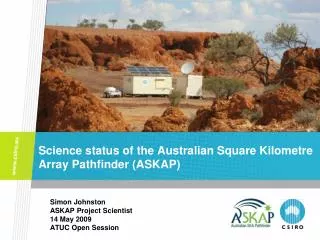
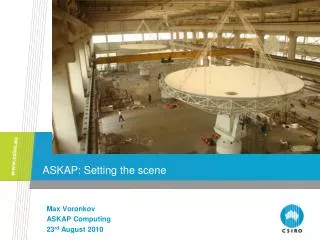
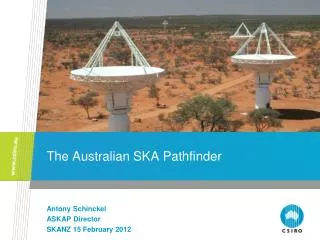
Australian SKA Pathfinder (ASKAP) • Sited at the Murchison Radio Observatory, Western Australia • Observes between 0.7 and 1.8 GHz • 36 antennas, 12m diameter • Started construction July 2006 • Data rate from correlator ~2.5GB/s • A DVD every two seconds! • Science processing requirement 200TF/s for basic capabilities • 800+TF/s for high angular resolution spectral line imaging
28 Gbit/s ~20 Gbit/s
The Pawsey High Performance Computing Centre for SKA Science AUD$80M super-computing centre Supports storage and processing of data from the Australian SKA Pathfinder and the Murchison WidefieldArray Construction completed April 2013
ASKAP Central Processor • 472 x Cray XC30 Compute Nodes • 200 TFlop/s Peak • Cray Aries (Dragonfly topology) • Cray SonexionLustre Storage • 1.4 PB usable • 480 x 4TB Disk Drives, RAID 6 + Hot Spares • Approximately 30 GByte/s I/O performance
Cray XC30 Compute Nodes Image Credit: Cray 472 x Cray XC30 Compute Nodes 2 x 3.0 GHz Intel Xeon E5-2690 v2 (Ivy Bridge) CPUs 10 Cores per CPU (20 per node) 64 GB DDR3-1866Mhz RAM
ASKAP Central Processor 1.4 PB (usable) Cray Sonexion Lustre storage • 16 x Ingest Nodes • 2 x 2.0 GHz Intel Xeon E5-2650 (Sandy Bridge) CPUs + 64GB RAM • 10 GbE connectivity to MRO • 4x FDR Infiniband connectivity to compute nodes and Lustrefilesystem • 2 x Login Nodes • 2 x Data Mover Nodes (dedicated to external data transfers)
2 x 56 Gbit/s IB per node 2 x 10 GbE per node
Data Services Sky Model Service Provides access to the Global Sky Model (GSM), an all-sky database with flux measurements in an appropriate frequency range to ASKAP RFI Source Service Responsible for managing and providing access to a database of known RFI sources that may impact ASKAP observations Calibration Data Service Provides an interface to a database containing calibration parameters
Challenges and Lessons Learned Per process memory footprint Disk I/O Fault Tolerance & Error Handling
Thank you CSIRO Astronomy and Space Science Ben HumphreysASKAP Computing Project Engineer t +61 2 9372 4211 eben.humphreys@csiro.au wwww.csiro.au Astronomy And Space Science