The Impact of Transport Costs on Industrial Location Factors
Transport serves as a crucial location factor for industries, heavily influencing the distribution of raw materials and finished products. Industries dealing with large, bulky goods, such as textiles and electronics, are particularly sensitive to transport costs. Variations between procurement and distribution costs, along with fixed terminal and variable haulage costs, shape the strategic positioning of factories. As transportation technologies evolve, and infrastructure improves, industries are drawn to regions with efficient transportation networks, creating a shift in industrial decentralization and regional specialization.

The Impact of Transport Costs on Industrial Location Factors
E N D
Presentation Transcript
Location factor Transport
Why is transport an important location factor? • Raw materials are unevenly-distributed • Transport is essential for moving RM and products
What sort of ind. is significantly influenced by transport cost? • Ind. producing large, heavy, bulky but low value goods • Examples: jewellery, computer/hi-tech and high quality fashionable clothes
2 types of costs • Procurement cost = cost of transporting RM to factory • Distribution cost = cost of transporting finished products to market
2 elements in transport costs (Hoover) • Terminal cost = cost of using terminal facilities for handling the goods and storage which is fixed. • Haulage cost/line haul cost = freight rate, e.g. wages paid to drivers, fuel used in transport, insurance, etc., which vary according to the length of journey
Tapering freight rate • Average transport cost falls with distance • Initial steep rise • But followed by gently tapering curve • Long haul cheaper ∵ TC is spread over • Short haul cost more ∵ need to pay fixed TC
Step-shaped relationship • Transport cost may increase in steps • e.g. MTR fare • Rate of increase↓as distance ↑ • Places far away from one another are charged the same • e.g. postage
Raw material-oriented industry • PC rises more rapidly than DC • Lower total cost near the RM • So, where is the optimal location for industries?
Market-oriented industry • DC rises more rapidly than PC • Total transport cost is lower at M • So, where is the optimal location for industries?
Break-of-bulk points • When goods must be transshipped from A to B (e.g. rail to ship), additional terminal & handling costs are incurred • It destroys the long-haul advantage • So locating factories at the transshipment point can avoid this extra cost • i.e. factories are usually located near ports/rail terminals • These points are called break-of-bulk points.
How were goods transported in the past? • Simple transport means like carts or boats • Primitive • Small carrying capacity • Low reliability
Influence on ind. location • High transport cost • Accounts for high % of total production cost • ∴ great influence on ind. location • Poor technology required more RM • PC > DC • ∴ RM-oriented
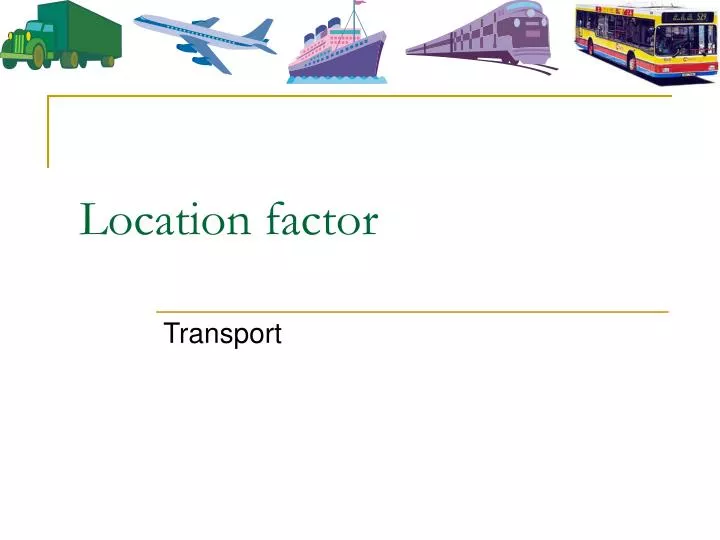
Means of transport nowadays • Sea/land/air • Mass transit • Speedy • Less costly • More reliable • Global deliveries possible
Influence on ind. location • Relatively lower transport cost • Accounts for very low % in production cost • Less influential than other factors/other factors being more important, e.g. labour • RM can be made more ubiquitous • ∴ Location is not tied to RM • Industrial decentralization is more than localization • Products are served for global market
Transport rates • TC for road is the cheapest • TC for air is the highest • For short haul, road transport is the cheapest • For long haul, sea transport is the cheapest • Zones identified
Locational flexibility of ind. ↑ • Many inputs are made ubiquitous • Availability of skilled and professional workers and IT are more important • Improved highways, railway and shipping services help lower transport cost
Industrial dispersion • Improvement in transport technology • Population decentralization (suburbanization) • Shift of labour from inner city to suburbs • Efficient linkages between inner city and suburbs • Cheaper land available for expansion • Results in industrial dispersion • e.g. industrial estates
Regional specialization of ind. • Well-developed transport networks attract more industries • Concentration of manufacturing ind. at nodal points • The no. of factories serving isolated market areas ↓ • Centralization in production • Enjoy scale of economies • Easy to specialize in particular kinds of production • Globalization high value operations + R&D in MDCs while low value labour operations in LDCs
Examples of regional specialization • Brewing in USA – Milwaukee • Automobile ind. in USA – Detroit • Automobile ind. in Nagoya, Japan • Ship-building around Inland Sea, Japan • Electronic ind. in Silicon Valley, USA • Textile ind. in Changjiang Delta, Central China • Toy industry in PRD