MULTI STORE MODEL
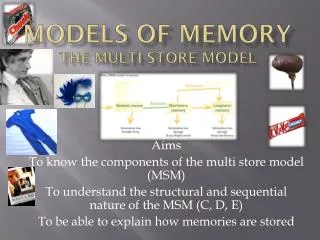
The Multi-Store Model of Memory, proposed by Atkinson and Shiffrin (1968), explains how memory processes operate through Sensory Memory (SM), Short-Term Memory (STM), and Long-Term Memory (LTM). Sensory Memory receives information from the five senses but retains it only briefly. If attended to, it transitions to STM, which has limited capacity (7±2 items) and lasts about 20 seconds without rehearsal. Through maintenance rehearsal, information can move into LTM, which has potentially unlimited capacity and duration, favoring semantic encoding, as suggested by Bahrick et al. (1975).


MULTI STORE MODEL
E N D
Presentation Transcript
MULTI STORE MODEL By Symren, Ellie and Indi
Atkinson & Shiffrin 1968 • It’s a structural model • It is an explanation of how memory processes work • Consists of SM, STM and LTM
SENSORY MEMORY • Composed of several stores, these are your 5 senses • Constantly receives information • Info. Only lasts for a brief period of time • If focussed on it enters the STM • :P
SHORT TERM MEMORY • Limited capacity and duration • Decay and displacement occur because of this • If maintenance rehearsal is done then it goes into LTM • Capacity is 7+or-2 (Miller) • Duration is 20 seconds if rehearsal is blocked • It prefers to be encoded acoustically
LONG TERM MEMORY • Potentially unlimited duration and capacity • Prefers to be encoded semantically • Bahrick Et Al study suggests that long term memory could last up to 48 years
BAHRICK ET AL • 1975 • His aims were