Download
1 / 16
160 likes | 263 Views
Recombinant DNA technology encompasses a series of techniques for combining genes from various sources and transferring them into cells for expression. Key components include restriction enzymes, which cut DNA at specific recognition sequences, producing sticky ends that facilitate the joining of DNA fragments. Gel electrophoresis aids in separating and analyzing these fragments based on size. Polymerase Chain Reaction (PCR) further amplifies DNA samples, allowing for swift, specific replication. Applications in creating genetically modified organisms (GMOs) like Super Salmon and FlavrSavr Tomato demonstrate its impact.

E N D
Biotechnology Applications and Basic Technology
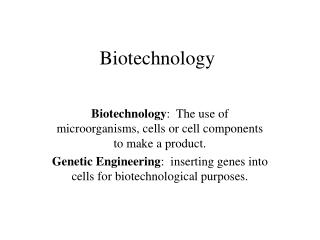
Recombinant DNA technology • Recombinant DNA technology: set of techniques for recombining genes from different sources and transferring into cells where it may be expressed
Restriction Enzymes • Occur in bacteria where they protect against intruding DNA • Involves restriction; foreign DNA is cut into small segments • Cut at specific points on small segments called specific recognition sequences • Several hundred restriction enzymes & ~ 100 different specific recognition sequences • Cuts DNA in staggered manner, resulting in single-stranded ends, called sticky ends
Creates restriction fragments • Used in lab to join DNA pieces from different sources • Temporary bonds held by weak H bonds • Can be made permanent by adding DNA ligase
Gel Electrophoresis • used to separate either nucleic acids or proteins based upon molecular size, charge and other physical properties • used to identify segments by looking at banding pattern when cut with restriction enzymes • DNA fragments can be isolated, purefied, and then recovered from gel
Electrical current is used to move charged particles at different rates
RFLP Analysis (restriction fragment length polymorphisms) • gel electrophoresis of restriction fragments results in characteristic banding pattern • Each band corresponds to DNA restriction fragments of certain length • Different alleles of gene result in dissimilar banding patterns • Similar patterns result when noncoding segments of DNA are used as starting materials
Fragments move different distances based on base pair length, size (how compact)
Recombinant DNA • Use restriction enzymes to alter DNA • Incorporate DNA into new organism to create a GMO (genetically modified organism) • Ex: Super Salmon, FlavrSavr Tomato • Super Salmon ABC Special
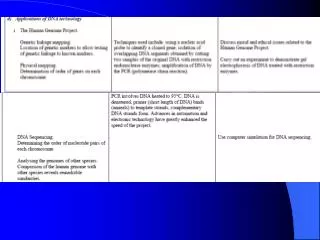
Polymerase Chain Reaction • Technique used to amplify (copy many times) DNA in vitro (inside the cell) • 1. DNA is incubated with special primers & DNA polymerase • 2. billions of copies of the DNA are produced in a few hours • 3. PCR is highly specific; primers determine sequence to be amplified • 4. only minute amounts of DNA are needed