Download
1 / 20
200 likes | 317 Views
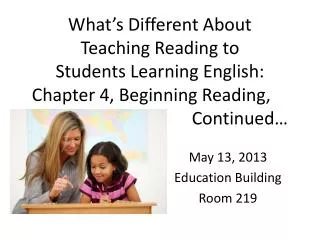
What’s Different About Teaching Reading to Students Learning English: Chapter 4, Beginning Reading, Continued…. May 13, 2013 Education Building Room 219. Why We Need to Teach Phonemic Awareness and Phonics. http://www.youtube.com/watch?v=gh5xu35bAxA. Goals and Objectives.

E N D
What’s Different About Teaching Reading to Students Learning English: Chapter 4, Beginning Reading, Continued… May 13, 2013 Education Building Room 219
Why We Need to Teach Phonemic Awareness and Phonics • http://www.youtube.com/watch?v=gh5xu35bAxA
Goals and Objectives Study Guide p. 131
Factors to Keep in Mind When Teaching Second Language Speakers to Read in English Study Guide p. 132
Let’s Play! Follow the Bouncing Ball Study Guide p. 144-145
Let’s Twist! • Developing Alphabet Recognition: Alphabet Twister Study Guide p. 147
What About Teaching Phonemic Awareness and Phonics to Older, Struggling Readers? “Just say no.” • Does not help these students read better… • Does not make them want to read more… Handout of Presenter’s Notes 2007 WIDA Manual 2012 WIDA Manual
Study Guide p. 151 WIDA RtI Guide: Literacy Factors
Some Strategiesto Build Meaning Ruth Tipei: Vocabulary Activity Cards
Some Strategiesto Build Meaning Diana Adkins: Before During and After Comprehension Cards
Some Strategiesto Build Meaning Ann: Snap Words