Metabolic Pathways: Formation of Glucose from Non-Animal Precursors
This overview explores the metabolic pathways responsible for the formation of glucose from precursors that are not derived from animals. Key processes include the conversion of 2-carbon compounds to glucose and the significance of acetyl-CoA in these transformations. It highlights the role of the glyoxylate cycle in converting stored compounds in plants to carbohydrates, along with the steps in the citric acid cycle, particularly involving citrate synthase and aconitase. Additionally, it touches on the transfer of metabolites across different metabolic compartments essential for converting acetyl-CoA to glucose.

Metabolic Pathways: Formation of Glucose from Non-Animal Precursors
E N D
Presentation Transcript
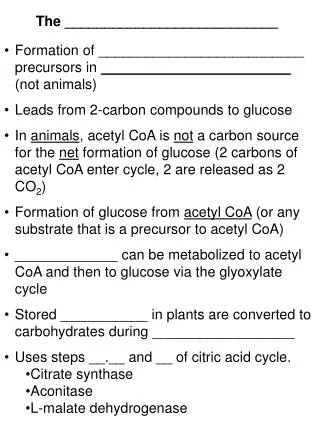
The ___________________________ • Formation of __________________________ precursors in ________________________ (not animals) • Leads from 2-carbon compounds to glucose • In animals, acetyl CoA is not a carbon source for the net formation of glucose (2 carbons of acetyl CoA enter cycle, 2 are released as 2 CO2) • Formation of glucose from acetyl CoA (or any substrate that is a precursor to acetyl CoA) • _____________ can be metabolized to acetyl CoA and then to glucose via the glyoxylate cycle • Stored ___________ in plants are converted to carbohydrates during __________________ • Uses steps __.__ and __ of citric acid cycle. • Citrate synthase • Aconitase • L-malate dehydrogenase
Two other steps Enzyme: _____________________ Enzyme: _____________________
Conversion of acetyl CoA to glucose requires the transfer of metabolites among three metabolic compartments • (1) The ____________ (2) The ____________ (3) The ____________