Enhancing Food Security and Livelihoods through Eco-Friendly Upland Rice Farming Techniques
Since 1998, Metta has been dedicated to promoting eco-friendly techniques for sustainable crop growth. Initiated in 2001, Farmer Field Schools (FFS) throughout Kachin State and other regions aim to boost food security for smallholder farmers. We focus on raising agricultural productivity through innovative practices in upland rice farming, emphasizing experiential learning. Our programs have trained thousands of farmers, resulting in significant yield increases and enhanced decision-making skills while reducing the use of chemicals and fostering women’s participation.
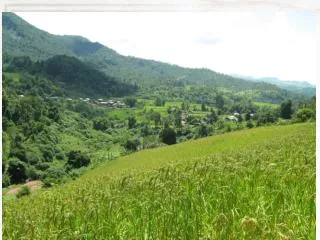

Enhancing Food Security and Livelihoods through Eco-Friendly Upland Rice Farming Techniques
E N D
Presentation Transcript
Background • Metta has been actively engaging with eco-friendly techniques for growing crops since 1998 • Initially Farmer Field Schools (FFS) began in 2001 in Kachin State, and now have been conducted in Kachin, Northern and Southern Shan, Kayar States and Ayeyawady Region
arwåm • FFS to LIFT the food security of small and marginal land holder • (2010-2013)
Specific Objective • To raise the food security and livelihoods status of the small and marginal farm holding households • To develop core groups of farmers skilled in upland rice farming • To develop a set of new practices effective to sustainably increase the productivity of rain-fed upland rice fields
Farmer Field School A typical field school consists of 20-25 farmer participants. Season long field study. Adult and non-formal education. Experiential learning, discovery based and learning by doing. Farmers, in groups, are learning from the actual situation, which builds their confidence
System of rice intensification (upland rice) • Used of quality seed • Sowing in line with small number of seed rate • Used of modify drum seeder • Used of modify weeder for regular weeding • Used of organic manure and compost • Timely harvest
FFS Process • Village Leaders’ workshop • FFS planning • Establishment of FFS’s committee • Establishment of study plot and meeting place • FFS’s regular session • Agro-ecosystem anlysis • Farmer level seed production • Action research • Farmer field visit and regular motoring • Cross visit and field days • Cost and return analysis • Participatory monitoring and evaluation
Farmer Adaptation • No of Farmer - 3,762 • Total Acres - 4,774 • Average Yield - 35 Baskets/acre • Baseline Yield - 15-25 baskets/acre • Net Increased Yield - 10 – 20 baskets/acre • 4,774 acre X 10 basket = 47,740 baskets (2,387 mt) • 47,740 baskets X 5 USD = 2,38,700 USD
Some Achievement • Enhance farmer decision making skill in upland rice farming • Reduce weeding time and labour cost • Increase women participation in different level • Men involvement in weeding • Enhance capacity of FFS committee • Reduce significant used of chemical • Increase food security period by 2 to 4 months
Challenges • Limited technology for rice in steep slope area • Access to remote and mountainous area during rainy season • Paying attention to cash crop rather than rice • Use of organic manure in large scale • Prominent use of herbicide in some area