Dysfunctional Individuation and Its Role in the Link Between Attachment Styles and Eating Disorders
This study explores the relationship between adult attachment styles, dysfunctional individuation, and disordered eating among female undergraduates. By replicating previous findings that associate insecure attachment with disordered eating, the authors propose that dysfunctional individuation serves as a critical mediator in this relationship. The results reveal significant correlations between dysfunctional individuation, positive self and other models, and eating disorders, highlighting its importance in understanding negative body image and psychological adjustment in late adolescence. Future research should investigate these dynamics across diverse populations.

Dysfunctional Individuation and Its Role in the Link Between Attachment Styles and Eating Disorders
E N D
Presentation Transcript
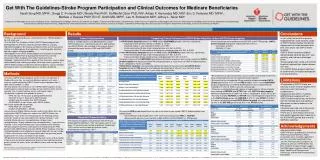
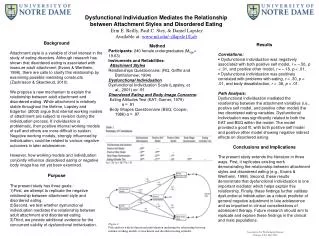
Dysfunctional Individuation Mediates the Relationship between Attachment Styles and Disordered Eating Erin E. Reilly, Paul C. Stey, & Daniel Lapsley Available at: www.nd.edu/~dlapsle1/Lab Background Attachment style is a variable of chief interest in the study of eating disorders. Although research has shown that disordered eating is associated with insecure adult attachment (Evans & Wertheim, 1998), there are calls to clarify this relationship by examining possible mediating constructs (Zachrisson & Skarderud, 2010). We propose a new mechanism to explain the relationship between adult attachment and disordered eating. While attachment is relatively stable throughout the lifetime, Lapsley and Edgerton (2002) argue that internal working models of attachment are subject to revision during the individuation process. If individuation is problematic, then positive internal working models of self and others are more difficult to sustain. Negative working models, strongly influenced by individuation, could be related to various negative outcomes in later adolescence. However, how working models and individuation conjointly influence disordered eating or negative body image has not yet been examined. Purpose The present study has three goals: First, we attempt to replicate the negative relationship between attachment style and disordered eating. Second, we test whether dysfunctional individuation mediates the relationship between adult attachment and disordered eating. Third, we provide additional evidence for the concurrent validity of dysfunctional individuation. • Results • Correlations: • Dysfunctional individuation was negatively associated with both positive self model, r = –.50, p < .01, and positive other model, r = –.18, p < .01, • Dysfunctional individuation was positively correlated with problems with eating, r = .30, p < .01, and body dissatisfaction, r = .38, p < .01. • Path Analysis: • Dysfunctional individuation mediated the relationship between the attachment variables (i.e., positive self model, and positive other model) the two disordered eating variables. Dysfunctional Individuation was significantly related to both the EAT and BSQ within the model. The model provided a good fit, with both positive self model and positive other model showing negative indirect effects on disordered eating. • Conclusions and Implications • The present study extends the literature in three ways. First, it replicates existing work demonstrating the relationship between attachment styles and disordered eating (e.g., Evans & Wertheim, 1998). Second, these results demonstrate that dysfunctional individuation is one important mediator which helps explain this relationship. Finally, these findings further validate dysfunctional individuation as a robust predictor of general negative adjustment in late adolescence and as important in clinical considerations of adolescent therapy. Future research should aim to replicate and explore these findings in the clinical and male populations. Method Participants: 240 female undergraduates (Mage= 19.63) Instruments and Reliabilities: Attachment Styles Relationships Questionnaire: (RQ, Griffin and Bartholomew, 1994) Dysfunctional Individuation Dysfunctional Individuation Scale (Lapsley, et al., 2001) α= .91 Disordered Eating and Body Image Concerns: Eating Attitudes Test (EAT; Garner, 1979) α = .91 Body Shapes Questionnaire (BSQ; Cooper, 1986) α = .97 Figure 1. Path analysis with dysfunctional individuation mediating the relationship between internal working models of attachment and disordered eating attitudes. Association for Psycholigical Science Chicago, USA May 2012