Plasma Window Technology: Challenges and Progress in High Vacuum Applications
This document discusses the challenges and advancements in plasma window technology, particularly in the context of the Heavy Ion Beam Driver (HIBD) and its operational requirements for high vacuum and intermediate pressures. Conducted at MIT and in collaboration with Brookhaven National Laboratory, the research examines throughput calculations, gas behavior, and the design of plasma windows utilizing argon and xenon. The need for scaling experiments and further investigations at lower pressures is highlighted, addressing practical applications and energy consumption concerns.

Plasma Window Technology: Challenges and Progress in High Vacuum Applications
E N D
Presentation Transcript
Plasma Window Performance Leslie Bromberg Katie Maurer Ady Herskovitch* MIT Plasma Science and Fusion Center ARIES meeting Madison, WI April 23, 2002 *Brookhaven National Laboratory, NY
HIBD-Chamber Vacuum Interface • Heavy Ion Beam Driver requires high vacuum for operation • 10-6-10-9 Torr • Chamber operation requires low to intermediate vacuum • 10-3 - 10 Torr • Because of the large openings required for beam propagation, large gas throughput across the HIB final focus and the chamber exits • Large vacuum pumping speeds required • Not clear whether it is possible to maintain that large pressure differential with the available space for pumps. • Can Flinabe pump Xe?
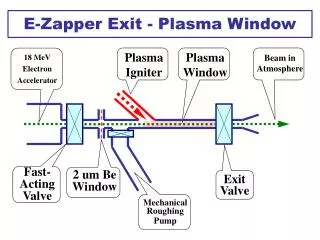
Plasma Window • Experiments at MIT for supporting work on a compact neutron source (Dr. R. Lanza, Dr. A. Herskovitch) • Funded in the past through LLNL
Throughput calculations • In the viscous regime (usually p > 100 mTorr), the throughput through a channel is Here, Q is the throughput, h is the gas viscosity, a is the diameter, and P’s are the pressure • Increased viscosity and decreased number density results in decreased flow through the opening. • If the channel is filled with a thermal plasma, both the viscosity increases and the number density decreases, decreasing the particle throughput.
Plasma windows for applications to HID • Demonstrated technology for intermediate pressure (in the viscous regime) • Preliminary experiments with Ar at atmospheric and higher pressures • Minimum pressure at low pressure side is ~30 mTorr (down from 100 mTorr) • Not clear how low it can reach with different gases, different size openings and lowered pressure at high pressure side of window • Need scaling experiments • Additional experiments at lower pressures and with other gases to come in the summer • Power consumption, per window, is probably (?) on the order of 50-200 W for 1 Torr operation with Xe • Requires dielectrics (?) • Already a conducting media