Download
1 / 18
190 likes | 355 Views
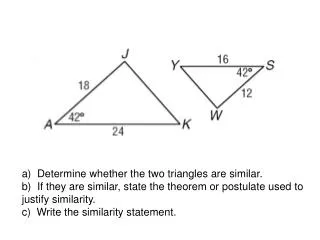
a) Determine whether the two triangles are similar. b) If they are similar, state the theorem or postulate used to justify similarity. c) Write the similarity statement. Yes, SAS ∆JAK ~ ∆WSY. a) Determine whether the two triangles are similar.

E N D
a) Determine whether the two triangles are similar. b) If they are similar, state the theorem or postulate used to justify similarity. c) Write the similarity statement.
Yes, SAS ∆JAK ~ ∆WSY
a) Determine whether the two triangles are similar. b) If they are similar, state the theorem or postulate used to justify similarity. c) Write the similarity statement.
No, sides are not proportional
a) Determine whether the two triangles are similar. • b) If they are similar, state the theorem or postulate used to justify similarity. • Write the similarity statement. • Solve for x
Yes, AA ∆LMN ~ ∆PQN X = 9
a) Determine whether the two triangles are similar. • b) If they are similar, state the theorem or postulate used to justify similarity. • Write the similarity statement.
Yes, AA ∆KSM ~ ∆TRQ
X = 9 Y =16
X = 108 Y = 180