Download
1 / 15
150 likes | 285 Views
This article explores the fascinating science behind flatulence, commonly known as farting, and its implications for air pollution and greenhouse gases. It delves into the constituents of flatus, including nitrogen and methane, and highlights the significant environmental impact of livestock methane emissions. Additionally, we discuss air pollution, its definition, health effects, and the importance of clean air standards established by the Clean Air Act. Discover how our daily actions, including natural processes like flatulence, can contribute to air quality issues.

E N D
The Science of Farting • The word "FART" can stand for: • Frequency Actuated Rectal Tremor • a.k.a. Flatulence or Intestinal Gas • The average human releases 0.5 to 1.5 litres (1 to 3 U.S. pints) of flatus (gas) in 12 to 25 episodes throughout the day
Constituents of Flatulence • The primary constituents of flatulence are • nitrogen (the primary gas released) • carbon dioxide • hydrogen • as well as lesser amounts of oxygen (ingested) and methane
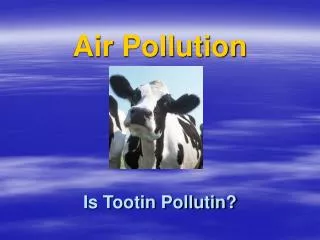
Can flatulence be harmful to the environment? • An average cow produces (through flatulence and/or burping) 280 liters of methane a day • What is methane? • CH4 • Greenhouse gas • Flatulence and the Greenhouse Effect • Is Tootin Pollutin?
Why is Cincinnati hazy? March 22, 2006 Ideal Conditions Cincinnati – Hazecam
NOTES What is Air Pollution? • Definition: • The presence of substances (chemical, physical, biological) in the air (due to man) in large enough concentrations to interfere with one’s: • Health • Comfort • Safety • Full use and enjoyment of property
NOTES The Clean Air Act • Government legislation passed in 1963 that focuses on the reduction of smog and atmosphericpollution by enforcing clean air standards. • Amendments made in 1970 and 1990.
NOTES Air Pollution – Fast Facts • The average adult breathes 3,000 gallons of air every day • Children breathe more / lb. of body weight • Respiratory systems developing • More Americans die from automotive air pollution than from highway automobile accidents • 1000 lung cancer deaths in Cincinnati: 900 smoking, 90 radon, 10 environmental • Short and long term exposure to air pollution has shown increased numbers of heart attacks and strokes
NOTES Two types of Air Quality Standards • Primary Standards • Establish limits to protect public health (especially sensitive populations: asthmatics, children, elderly) • Secondary Standards • Establish limits to protect public welfare (visibility, animals, crops, vegetation, buildings)
NOTES Six Criteria Air Pollutants • Ox ~ Ozone (O3) • SOx ~ Sulfur Oxides (SO2) • NOx ~ Nitrogen Oxides (NO2, NO3) • COx ~ Carbon Monoxide, Carbon Dioxide (CO, CO2) • POx ~ Lead (Pb) • ROx ~ Particulate Matter (PM) Click on the picture for our current AQI
NOTES Nonattainment Areas - 2002 A geographical area that does not meet air quality standards for one of the six criteria pollutants Map from http://www.epa.gov/airtrends/non.html
NOTES EPA tracks two air pollution trends • Air concentrations • Actual measurements of pollutant concentrations in ambient (outside) air • Performed at monitoring sites • Emissions • Estimates of total tons of pollutants released into the air each year
NOTES What does a “TON” look like? • 1 ton = 2,000 lb
Is Tootin Pollutin? • What do you think?