Download
1 / 9
90 likes | 219 Views
This lesson explores the significant events leading to World War II, including critical dates like 1931, 1935, September 1, 1939, December 7, 1941, and June 22, 1941. Students will watch the "Road to War" video, taking notes on key topics such as the fall of France, the Battle of Britain, and U.S. losses at Pearl Harbor. We will analyze the collaboration of Vichy France with the Nazis and how Britain, under Churchill's leadership, stood firm against Axis powers. This comprehensive overview will help students understand the geopolitical landscape preceding the global conflict.

E N D
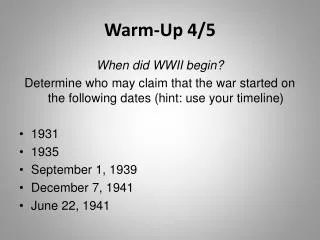
Warm-Up 4/5 • When did WWII begin? • Determine who may claim that the war started on the following dates (hint: use your timeline) • 1931 • 1935 • September 1, 1939 • December 7, 1941 • June 22, 1941
Agenda 4/5 • Warm-Up/HW Check • Finish “Road to War” video • Notes
“Road to War” Questions • Take notes as you watch on the following: • Ardennes Forest • Battle of Britain • Hitler’s invasion of the Soviet Union • U.S. losses at Pearl Harbor
Notes Assignment #37 (continued)
France Falls • May 1940 – Hitler focuses on Ardennes • Belgium surrenders; French stranded at Dunkirk • Italy declares war on GB, France and attacks from South • June 14: Paris falls
Vichy France • Marshal Petain takes over southern France • Vichy government under Petain collaborates with Nazis • Charles De Gaulle flees to London and sets up government-in-exile
Battle of Britain (1940-41) • GB now stands alone against Nazis • Churchill vows never to give in • RAF uses radar and Enigma = pivotal • Outcome: Hitler’s advances can be blocked
North Africa • Italy focuses on Suez Canal in Egypt • Britain fights back with a vengeance; Italy needs Germany to help • General Erwin Rommel (“Desert Fox”) commands the Africa Korps
The Balkans • Bulgaria, Greece, Romania, Yugoslavia, Hungary, Turkey • Key to Hitler’s plan to attack USSR • Countries in red join Axis powers • Yugoslavia and Greece fall to Nazis