Download
1 / 2
20 likes | 156 Views
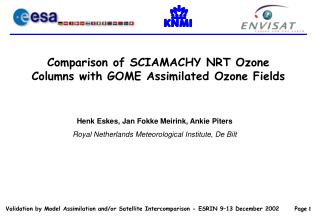
This document presents a comparative analysis of ozone vertical column density (VCD) processing methods by the DLR-IMF team, specifically focusing on the use of reference spectra from GOME-FM and SCIAMACHY-FM. It highlights the initial test settings known as DJO settings, and the use of NRT prototypes. Significant deviations were observed in VCD measurements, with DLR settings leading to 4-8% higher VCD values compared to DJO settings. The findings are illustrated with a plot of VCD ratios that provide visual insight into the discrepancies.

E N D
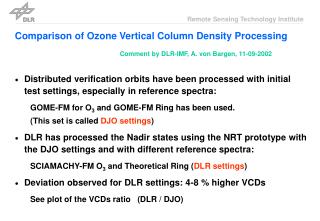
Comparison of Ozone Vertical Column Density Processing Comment by DLR-IMF, A. von Bargen, 11-09-2002 • Distributed verification orbits have been processed with initial test settings, especially in reference spectra: GOME-FM for O3 and GOME-FM Ring has been used. (This set is called DJO settings) • DLR has processed the Nadir states using the NRT prototype with the DJO settings and with different reference spectra: SCIAMACHY-FM O3 and Theoretical Ring (DLR settings) • Deviation observed for DLR settings: 4-8 % higher VCDs See plot of the VCDs ratio (DLR / DJO)