Hydrocarbon Detection & Remediation Pilot Project
170 likes | 290 Views
The Hydrocarbon Detection and Remediation Pilot Project aims to address the significant issue of VOC emissions from the oil and gas industry, estimated at over 2000 tons per year, contributing to ozone problems in Corpus Christi. Utilizing innovative technologies such as Airborne LIDAR and the ITT ANGEL system, this project will identify methane emissions and implement cost-effective remediation solutions. Through an extensive flight plan over different hydrocarbon emission sites, the project will demonstrate that cleaner operations lead to increased profitability and serve as a national model for the industry.


Hydrocarbon Detection & Remediation Pilot Project
E N D
Presentation Transcript
Background VOC emissions from the Oil & Gas Industry are estimated to be more than 2000 tons per year
Fugitive Methane Emissions • Fugitive Emissions are a significant contributor to the Corpus Christi ozone problem.
New Technology Ejector Vapor Recovery
New Detection Technology • Airborne LIDAR • Mid IR Range
Project Objectives Assist in the demonstration and beta test of ITT’s ANGEL system. Assist with the demonstration of Comm Engineering’s EVR unit for vapor recovery.
Overall Objective Identifying emissions leads to remediation. Demonstrate cost effective remediation.
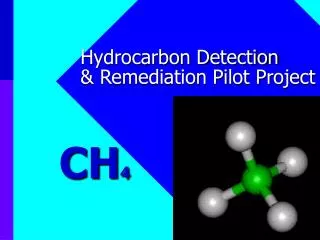
Industry Motivation H | H-C-H | H
Industry Motivation $ | $-$-$ | $ $6.55/ MCF
Procedure Aircraft will over fly 4 sites with different hydrocarbon emissions 1. Gas well site to detect VOC/CH4 emissions 2. SERF to detect diesel on water 3. TPWD hatchery facility to detect propane over water 4. TPWD hatchery facility to detect gasoline vapors
No emissions over flightFollowed by an emissions richover flight. Each site will have communication with the A/C Once a baseline is established emissions will be released.
TAMUCC Provides GIS support Permitting functions Ground personnel Site weather data
Comm Engineering provides • Ground truth measurements at gas well site • EVR unit at well site
ITT Provides Aircraft and ANGEL system Personnel for operation Analysis of data
Results to be presented The goal is to present the findings at a symposium here at TAMUCC . The target audience is the oil and gas industry in the area. Objective: To demonstrate that cleaner operations result in more profits.
Significance • Substantial Reductions in Emissions • National Model for Industry
Industry Partner to provide surface facility for study