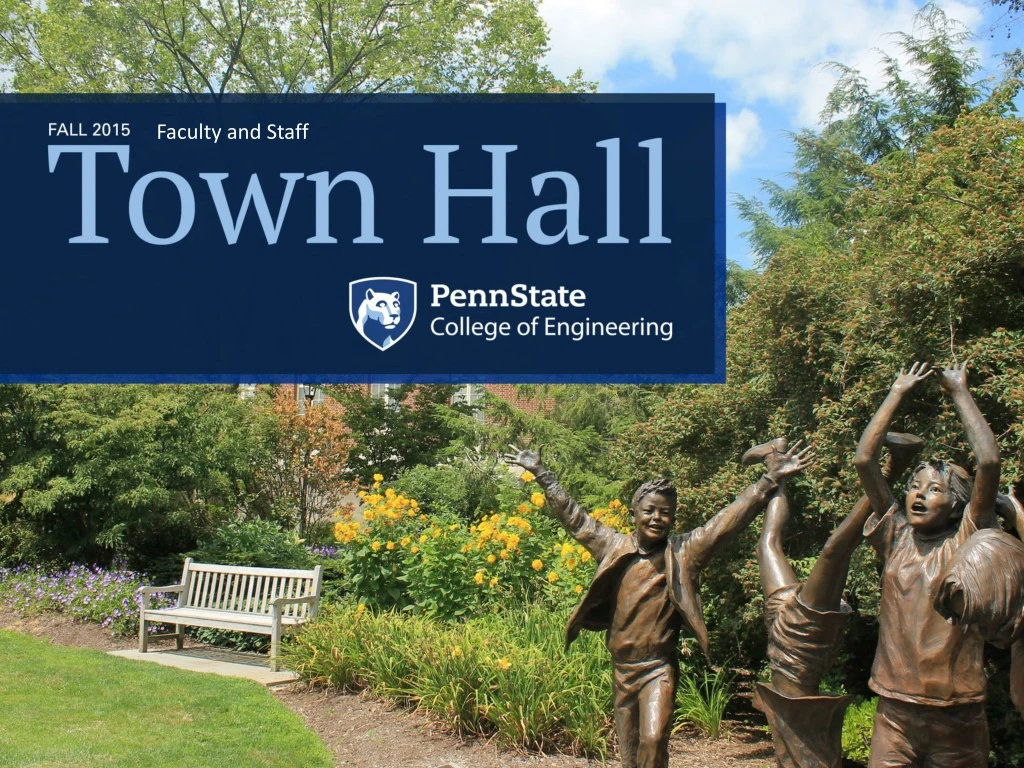
College of Engineering Growth Strategy to Achieve Global Preeminence
110 likes | 139 Views
A comprehensive plan outlining growth strategies for faculty, staff, and facilities at Penn State's College of Engineering to achieve global preeminence. Includes benchmarks, faculty hiring, financial analysis, and climate survey results.


College of Engineering Growth Strategy to Achieve Global Preeminence
E N D
Presentation Transcript
One-year MS/MEng Actual # of students Target # of students 85 100 10 available now, 6 expected for FA15 submission: Architectural Engineering, Real Estate Development, Building Envelope Systems, Biomedical Engineering, Nanoscience, Engineering Science
Blueprint for Global Preeminence GOALS: Show how much the College of Engineering contributes to Penn State and Show how we compare to other universities so we can make improvements to Present a five-year plan for growth of faculty, staff and facilities
Blueprint for Global Preeminence CONTENTS: Strategy Education and Research Thrusts Benchmarks Implementation Plan Faculty Composition Administration and Support Services Space and Infrastructure Financial Analysis
Entrance to Major Assessment PSU currently: Many schools: • C or better in select courses • Minimum GPA • ETM in 4th semester • No guarantee; controls • ETM in freshman • Some students know what they want • Complications associated with change • Ad hoc committee with EFC involvement Hybrid/LionPATH • Some direct admits, others can come later if space • Opportunity to enter the major early • Rewards highly motivated students
Climate Survey ENGAGE: Enhancing the Learning and Working Environment at Penn State Engineering • Sorely needed community benchmarks • Survey of all sub-communities • Rankin and Associates assisting • Survey Feb. 2016; report mid-summer • All inclusive committee
Project-based Learning Assessment Investigate the possibility of establishing a PSU model for PBL in large public universities • Target enrollment of 30 students/year • Cohort-based to build community Innovations over traditional curricula: • Design across all 4 years • Inquiry-based methods in lab courses • Self-directed learning, including meta-cognition • Develop ability to be innovative, entrepreneurial • Pervasive integration of humanities
REU and BEU REU program established in 2014 to give undergraduate students research experience with a faculty member UP REU: Multi-Campus REU: • 88 students (21 female, 67 male, 17 intl) since summer of 2014 • Six-week summer program: 33 students, 6 campuses, 49 faculty members BEU • Initiative from CoE to provide business training, enabling students to wrap business plans around their engineering project/product; support of Smeal • Will be launched in summer of 2016 • Inaugural cohort of up to 10 engineering students
Salary Adjustment Program Average Salary Increases for Staff FY 2011-12 FY 2012-13 FY 2013-14 1.54% 3.02% 2.96% FY 2014-15 FY 2015-16 3.07% 3.19% Negotiated Extra: $30,000 Negotiated Extra: $12,000