Download
1 / 13
130 likes | 240 Views
This project report delves into the carbon footprint of a university campus and its causality drivers, comparing with peer institutions. The study covers various aspects such as transportation, solid wastes, and agricultural wastes, aiming to understand and improve sustainability efforts. The analysis includes data on purchased electricity, stationery sources, and different types of emissions drivers. The report also discusses observations, methodology, outliers, and recommendations for future studies.

E N D
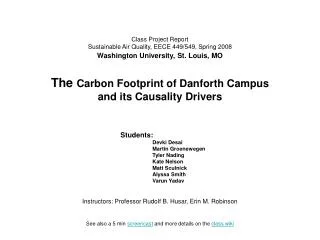
Class Project ReportSustainable Air Quality, EECE 449/549, Spring 2008Washington University, St. Louis, MOThe Carbon Footprint of Danforth Campusand its Causality Drivers Instructors: Professor Rudolf B. Husar, Erin M. Robinson Students: Devki Desai Martin Groenewegen Tyler Nading Kate Nelson Matt Sculnick Alyssa Smith Varun Yadav See also a 5 min screencast and more details on the class wiki
WU Comparison with Other Universities Martin Groenewegen Tyler Nading
What is in this analysis: Carbon assessments from other schools Use to make sense of WU's report Different data Purchased electricity Stationery sources (labs, steam generation, etc) Transportation (University fleet, Commuting students, Commuting Faculty and Staff) Ag Wastes Solid Wastes
Colleges and Universities • Carleton College • Harvard • Tufts University • University of New Hampshire • Smith College • Lewis and Clark • Middlebury College • University of Central Florida • Penn State University Park • Tulane University • Utah State University • Oberlin College • Duke University • University of Pennsylvania • Colby College • Wellesley College • Rice University • University of Illinois at Chicago • Penn State • College of Charleston • Yale • University of California, Santa Barbara • California State Polytechnic University • University of Connecticut • University of California, Berkeley • Amherst College • College of William and Mary • UT, Knoxville • Connecticut College • Occidental College • Colorado State University
Why analyze the others Determining scope of emission Finding new ways to handle a lack of data/estimations with limited details Method validation Structuring of the Wash U report
Tr-CSt=Transportation Commuting Students PE=purchased electricity Tr-CSF=Transportation Commuting Fac. Staff ST=Stationery sources Tr-A=Transportation Air Re=Refrigerants SW=Solid Wastes Tr-UF=Transportation University Fleet Ag=Agriculture Wastes
Duke Wash U
And the Study Shows: Wash U is average Overall correlation between size and emission Some out liars do exist Improvements • Do this study for a longer period of time using interim reports • Check the units • Comprise more comparisons for the given student body populations
Analysis of Transportation Sector From Other Schools’ Inventories • Purpose • Examine methodology used by other schools to account for transportation emissions • Determine trends/drivers for transportation emissions • Use findings as measuring stick for WU • Methodology observed • Error observed
Linear trend observed • Variance observed and expected • Duke and Penn outliers