Understanding Basic Chemistry: Atoms, Elements, and Bonding
This overview of basic chemistry introduces the fundamental building blocks of matter: atoms, which are the smallest units of elements and comprise protons, neutrons, and electrons. It explains the importance of subatomic particles and their roles, the concept of isotopes, and the formation of compounds and mixtures. The guide also covers ionic and covalent bonding, detailing how atoms achieve stability through electron exchanges or sharing. Perfect for beginners, this resource clarifies core chemistry concepts in an engaging manner.

Understanding Basic Chemistry: Atoms, Elements, and Bonding
E N D
Presentation Transcript
Basic Chemistry Jennifer Pogue September 11, 2012
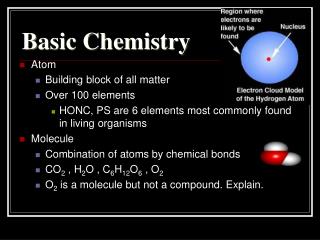
Atoms • The smallest part of an element that has all the properties of that element. • Consists of protons, neutrons & electrons
Subatomic Particles • Proton • Positively charged • Found in nucleus • Determines identity of atom—atomic number • Contributes to the mass of the atom
Subatomic Particles • Neutron • Neutrally charged • Found in nucleus • Contributes to mass of the atom
Subatomic Particles • Electron • Negatively Charged • Found in energy levels • Negligible mass • The Movers & Shakers of the atom
“Happy” Atoms • Atoms want complete outer (valence) energy levels. • They gain, lose, or share electrons to achieve “happiness”. • Goal = 8 valence electrons—called an octet
Elements • A substance that cannot be broken down into smaller parts by ordinary means • Listed on periodic table
Compounds • Atoms of two or more different elements chemically combined. • New substance has new properties.
Molecules • Smallest part of a compound that has all the properties of the compound
Mixtures • Two or more substances physically combined. • Substances retain individual properties.
Types of Mixtures • Homogeneous—same composition throughout the sample • Heterogeneous—different composition through the sample
Isotopes • Forms of an element with same number of protons but differentnumber of neutrons • Have same atomic numbers • Have different mass numbers
Isotope Symbols Element Symbol Mass Number Atomic Number Mass Number = # protons + # neutrons
The Difference? This carbon atom has 6 protons & 6 neutrons. This carbon atom has 6 protons & 8 neutrons.
You try… • What is the symbol for an atom with 23 protons and 27 neutrons? (Assume 23 electrons.)
Ions • A charged atom • Formed when atoms gain or lose electrons
Cations • Formed from metals • Left side of PT • Postively Charged atoms • Lose electrons
Anions • Formed from nonmetals • Right side of PT • Negatively Charged atoms • Gain electrons
Ion Symbols Charge Mass # Atomic # Charge = Protons - electrons 11 protons, 12 neutrons, 10 electrons
You Try… • What is the symbol for an atom that has 30 protons, 35 neutrons, and 28 electrons?
One more… • What is the symbol for an atom with 9 protons, 10 neutrons, and 10 electrons?
Bonding • Opposites attract! • Ionic bond • Metal + Nonmetal • Cation + Anion = no overall charge • Electrons change places • Covalent Bond • Nonmetal + Nonmetal • Electrons are shared between two atoms